TL;DR:
- Flooding can occur from even an hour of steady rain due to drainage system failure or insufficiency. Proper design, maintenance, and understanding of surface water management are essential for Southampton homeowners to prevent flood risks effectively. Upgrading infrastructure and using sustainable drainage solutions can improve resilience, but a comprehensive approach is necessary for lasting protection.
Flooding does not wait for a once-in-a-decade storm. Even an hour of steady rainfall can send water pooling across your garden, seeping under your back door, or backing up through a ground-floor drain. The uncomfortable truth is that many Southampton homeowners assume flooding is purely a weather problem, when in reality it is just as often a drainage problem. Understanding how your drainage system works, how it was designed, and where it can fall short gives you a real advantage when the skies open and the rain does not stop.
Table of Contents
- Why drainage is key to flood prevention
- How drainage is designed to handle stormwater
- Modern approaches: Traditional drains versus SuDS
- Drainage resilience and capacity: Why upgrades matter
- What most homeowners overlook about drainage and flood prevention
- Drainage solutions for Southampton homeowners
- Frequently asked questions
Key Takeaways
| Point | Details |
|---|---|
| Rapid water removal | Moving surface water away swiftly is the number one way drainage stops floods. |
| Custom design matters | Sizing systems for specific storms and property layouts improves effectiveness and resilience. |
| Choose the right system | SuDS and traditional drains offer different benefits and challenges; consider your site conditions before deciding. |
| Maintenance is essential | Regular checks and upgrades make your drainage more resilient to severe weather. |
| Professional support helps | Expert advice and local surveys ensure solutions are tailored to your home’s needs. |
Why drainage is key to flood prevention
Now you have seen why flooding is not only about heavy rain, let us break down how drainage actively prevents water building up around your home.
At its core, drainage is a race against time. When rain falls onto a paved driveway, a tiled roof, or a compacted lawn, it has nowhere to go except across the surface. The job of your drainage system is to collect that water and move it away before it accumulates to a damaging level. As drainage design guidelines make clear, “drainage systems reduce flood risk mainly by removing surface water from the site safely (and quickly enough), thereby limiting the duration and severity of flooding impacts.” Every minute that water sits on your property, it is looking for the path of least resistance, which is often through your doorway or into your foundations.
Even a small delay in drainage can be the difference between a damp path and a flooded kitchen. Speed and capacity both matter.
For Southampton homeowners, this is particularly relevant given the city’s mix of Victorian terraces, modern estates, and low-lying coastal areas. Water management is not a luxury, it is a necessity. Here is what needs to work together for your property to stay dry:
- Roof drainage: Gutters, downpipes, and gullies must be clear and correctly sized.
- Driveway and path drainage: Channel drains or permeable paving prevent water from running towards the property.
- Garden drainage: Soakaways, French drains, and graded surfaces direct water away from foundations.
- Connection to the sewer network: Surface water drains must flow freely to their outfall.
Our drainage infrastructure guide goes into detail about how each of these layers connects. And if you are unsure about your current setup, understanding surface water drainage principles is the right starting point.
How drainage is designed to handle stormwater
Understanding why drainage matters is only half the picture. How these systems are sized and planned is what helps them succeed when storms arrive.
Drainage engineers do not simply install the largest pipe they can find and hope for the best. They use established calculation methods to match a system’s capacity to the realistic storms a site will experience. One widely applied approach is the Rational Method, which calculates peak flow rates based on rainfall intensity, the area being drained, and how quickly different surfaces shed water. A recognised hydraulic methodology involves “sizing drainage capacity to storm events and using hydraulic calculations grounded in hydrology/hydraulics and recognised methods (e.g., Rational Method for peak flows in pavement drainage contexts).”
In plain terms, this means your drainage system was likely built to cope with, say, a one-in-ten-year storm, not a one-in-hundred-year event. Knowing that helps set realistic expectations.
What goes into drainage design for a typical home
- Calculating impermeable area: Designers measure all the hard surfaces that shed water, roofs, drives, patios, and paths.
- Assessing runoff rates: Each surface type sheds water at a different speed. A slate roof sheds water faster than a gravel path.
- Choosing pipe diameters: Pipe size is matched to the calculated peak flow rate, with a safety margin built in.
- Selecting a discharge point: Water must go somewhere. This might be a soakaway, a watercourse, or the public sewer.
- Accounting for infiltration: Gardens and grassed areas absorb some water, reducing the burden on pipes.
| Factor | What it affects | Why it matters |
|---|---|---|
| Impermeable area | Volume of runoff | More hard surfaces means more water to manage |
| Rainfall intensity | Peak flow rate | Heavier rain demands greater pipe capacity |
| Soil type | Infiltration rate | Clay soils absorb little; sandy soils absorb much more |
| Pipe gradient | Flow velocity | Too shallow and sediment builds; too steep and erosion occurs |
| Outfall condition | System efficiency | A blocked outfall can undermine an otherwise perfect system |
One thing that surprises many homeowners is that bigger is not always better. Oversized pipes can slow water to a trickle, allowing silt and debris to settle inside and gradually reduce capacity. Good design matches pipe size to actual need.
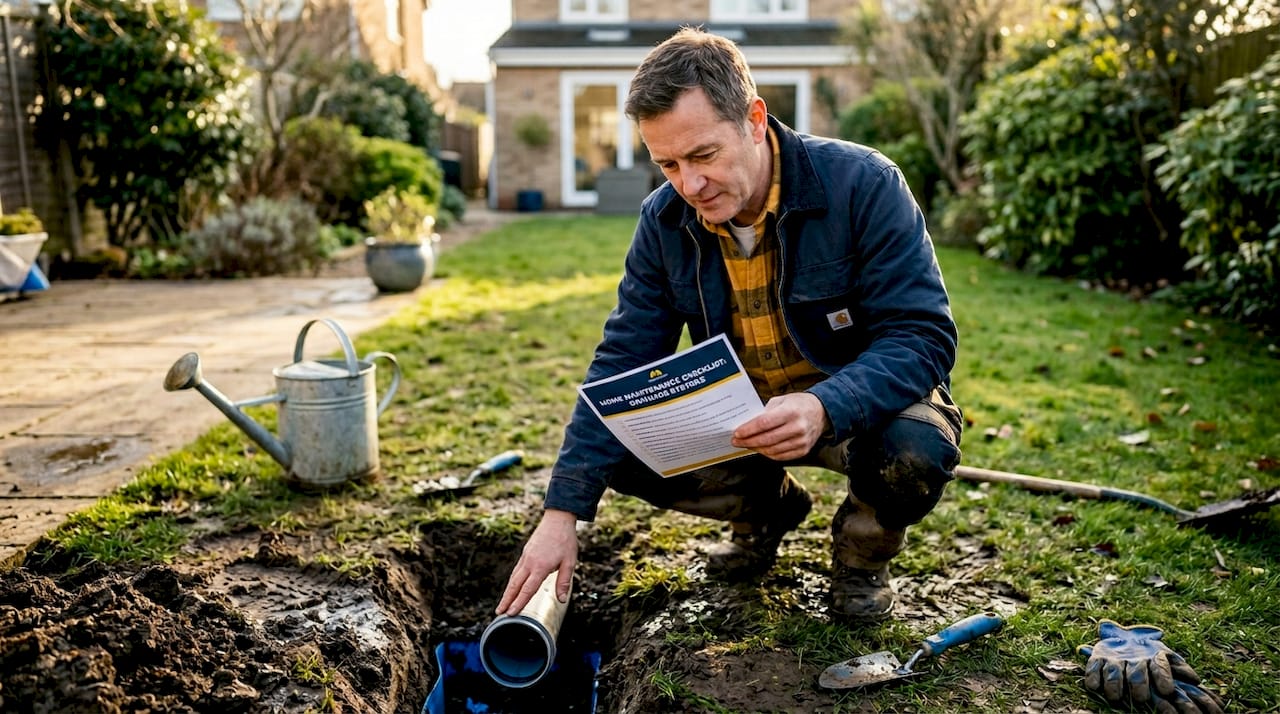
Pro Tip: If you are planning a new driveway or garden hard-standing, get a drainage assessment first. Adding large areas of impermeable surface without upgrading your drain network is one of the most common causes of garden flooding we see across Southampton.
Our guide to common drainage solutions includes practical options for different property types, and if your home is older, the page on drainage for older properties addresses the specific challenges of ageing infrastructure.
Modern approaches: Traditional drains versus SuDS
That design logic sits at the heart of traditional piped drainage, but Southampton homes now face new choices, including sustainable drainage systems designed for our changing climate.
Traditional drains work on a simple principle: collect water and pipe it away as quickly as possible. They are reliable, well understood, and relatively easy to maintain. Sustainable drainage systems, or SuDS, take a different approach. Instead of racing water off-site, SuDS slow it down, store it, and release it gradually. Common SuDS features include rain gardens, permeable paving, swales (shallow channels filled with vegetation), and underground storage tanks.
As SuDS performance considerations from Parliamentary research highlight, the effectiveness of these systems depends heavily on local site conditions, especially soil type and available space. Westminster City Council’s guidance on SuDS performance notes that “for SuDS-style approaches, the flood-prevention function is often to slow runoff and attenuate peaks (through storage, infiltration, and controlled release) rather than only piping it away; however, retrofit performance depends on site constraints and can vary.”
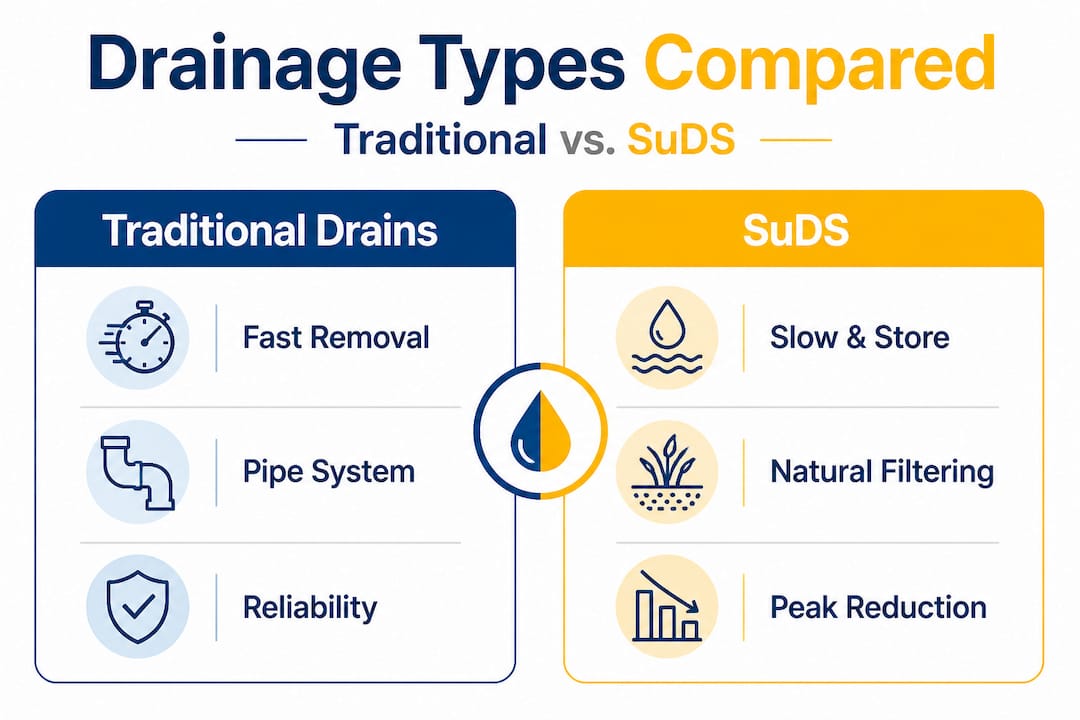
Comparing traditional drains and SuDS
| Feature | Traditional drainage | SuDS |
|---|---|---|
| Primary function | Remove water rapidly | Slow and store water |
| Installation cost | Moderate | Moderate to high |
| Retrofit suitability | Generally straightforward | Depends on soil and space |
| Maintenance needs | Periodic jetting and checks | Regular inspection of planting and storage |
| Performance in heavy rain | Can be overwhelmed quickly | Attenuates peak flows |
| Benefit for water quality | Limited | Often improves water quality |
SuDS genuinely shine in new-build situations where designers can plan them in from the start. Retrofitting them into an established Southampton terrace is a different matter. You might not have the garden space for a meaningful rain garden, or you might be sitting on clay soil that simply cannot absorb water quickly enough to make infiltration-based systems work.
- Permeable driveways work well for many Southampton semi-detached homes with adequate subsoil drainage.
- Rain gardens need a minimum area to be effective. A small patch will not manage heavy downpours.
- Underground storage tanks offer retrofittable SuDS-style attenuation but come at a higher cost.
- Not every SuDS feature is appropriate for every property. Professional assessment matters.
Pro Tip: Before committing to a SuDS feature, ask a drainage professional to assess your soil type. In parts of Southampton with heavy clay, an attenuation tank with a controlled outlet will outperform an infiltration-based soakaway every time.
For a closer look at what technology now makes possible, our page on modern drainage technologies covers options from smart sensors to permeable surface systems.
Drainage resilience and capacity: Why upgrades matter
But whether you rely on traditional drains, new SuDS, or both, how well will your system stand up to the next downpour? Here is why ongoing resilience and upgrades matter for Southampton’s homes.
Every drainage system has a maximum capacity. When rainfall exceeds that capacity, water goes somewhere else, and that somewhere else is usually your garden or your ground floor. The key insight many homeowners miss is that resilience is not just about the size of your pipes. It is about the whole system working reliably together. Research into drainage upgrade approaches confirms that resilience in drainage “is not only a matter of installing larger assets; upgrades that increase operational capacity (e.g., pumps) and smart/managed systems can improve performance during intense storms, but all systems remain vulnerable to capacity exceedance.”
No drainage system is flood-proof. What a well-maintained, well-designed system offers is reduced risk and reduced damage when extreme events occur.
Here is a practical approach to building resilience into your home’s drainage:
- Schedule regular inspections: CCTV drain surveys reveal partial blockages, root intrusion, and structural faults before they cause problems.
- Clear gullies and gutters seasonally: Leaf fall in autumn blocks surface water entry points faster than most homeowners expect.
- Check your outfall: Find out where your surface water drains to and confirm it is flowing freely, especially before winter.
- Plan an overflow route: Where would water go if your system reached capacity? Knowing this lets you protect vulnerable areas proactively.
- Consider sump pumps for low-lying areas: In parts of Southampton that sit below road level, a pump can be the difference between a damp floor and a dry one.
Smart systems are increasingly accessible too. Sensor-based monitors can alert you when a gully or pipe is approaching blockage levels, giving you time to act before an incident. These are not just for commercial properties anymore. Keeping your system blockage-free is the most cost-effective form of flood prevention you can invest in.
What most homeowners overlook about drainage and flood prevention
We have shown the mechanics and logic of good drainage, but what do most people still get wrong about keeping their homes dry? Here is a plainspoken take from years of working with Southampton properties.
The most dangerous assumption homeowners make is that their drainage system is either working or broken. In reality, drainage performance exists on a spectrum. A system can be functioning, processing everyday rainfall adequately, while being only one blocked gully away from letting you down badly during a downpour. The weakest link in your drainage chain determines the capacity of the whole chain. That is not a metaphor. If your outfall pipe is partially blocked, it does not matter how generously sized your surface drains are. Water will back up regardless.
We regularly see homeowners who have invested in larger pipes or new channel drains, only to discover that their connection to the public sewer was the bottleneck all along. Bigger pipes upstream of a restricted outflow simply hold more water briefly before backing up. The limits of drainage systems are real, and they apply even to newly upgraded installations.
Another overlooked factor is the role of neighbours and shared infrastructure. Many Southampton properties share drainage runs with adjacent houses. A blockage two doors down can affect your system’s ability to drain. This is one reason we always recommend getting advice from local experts who understand how the city’s older sewer networks are laid out. Local knowledge is not a nice-to-have. It is genuinely useful when tracing the source of a recurring drainage problem.
Finally, there is the issue of planned overflow. Every professional drainage designer builds in a route for water to go when the system is overwhelmed. Most homeowners have no idea where that route is, or whether it is clear. Identifying your property’s overflow path and keeping it unobstructed is a simple, free action that could prevent significant damage.
Drainage solutions for Southampton homeowners
Armed with the facts, you are ready to take practical steps. Here is how Southampton specialists can help.
Understanding your drainage system is one thing. Knowing it is in good condition and fit for purpose is another matter entirely. A professional assessment can reveal hidden vulnerabilities, partial blockages, or design mismatches that are silently increasing your flood risk every time it rains.
Our local drainage services cover everything from routine maintenance and emergency callouts to full system upgrades and soakaway installations. If you want to understand exactly what is happening inside your drains without unnecessary excavation, our professional drain surveys use CCTV technology to give you a clear picture of pipe condition, blockages, and flow performance. Where repairs are needed, our non-invasive drain repair options can often resolve structural issues without digging up your garden or driveway. Getting ahead of drainage problems before the next bout of heavy rain is always the more affordable choice.
Frequently asked questions
What is the most important feature in a home drainage system for preventing floods?
The ability to safely and quickly remove surface water from your property is central to flood prevention, as limiting flood severity depends directly on how fast and safely water can be carried away from the site.
How do SuDS differ from traditional drainage in flood prevention?
SuDS slow and store water to reduce peak runoff rates, while traditional drains aim to remove water rapidly. As noted in SuDS guidance, retrofit performance varies significantly depending on soil conditions and available space.
Why should Southampton homeowners consider upgrading their drainage systems?
Upgrades such as additional pumps or smart monitoring genuinely improve performance during intense storms, but as research confirms, all systems remain vulnerable to capacity exceedance, making ongoing maintenance just as important as the upgrade itself.
Is bigger always better for drainage pipes?
No. Oversized pipes can cause silt to settle and restrict flow, and they only improve performance if the entire drainage pathway, including outfalls and receiving sewers, is also capable of handling the increased volume. Capacity depends on the whole drainage pathway, not just one section of it.
Recommended
- How local drainage experts protect Southampton homes
- Surface water drains: Essential guide for Southampton homeowners
- Drainage infrastructure: essential guide for Southampton homes
- How drainage impacts property value: Southampton guide
- Drain Surveys London | CCTV Drainage Inspections & Reports – Pest Control 24 London