
TL;DR:
- Older Southampton properties often face drainage problems caused by system undersizing, material deterioration, and extreme weather events, despite their age. These issues require specific diagnosis and tailored repairs, as foul and surface water drainage fail for different reasons, and their maintenance must be managed separately. Proactive, diagnosis-led interventions and regular system checks are essential to prevent costly failures driven by today’s climate and aging infrastructure.
Older properties in Southampton carry a certain charm, but beneath the surface, their drainage systems are often struggling with problems that have nothing to do with age alone. Many homeowners assume that if a drain was working last year, it will work this year. That assumption is increasingly wrong. Shifting rainfall patterns, original design constraints, and years of missed maintenance are combining to overwhelm systems that were never built for today’s conditions. This guide explains exactly what is going wrong, why it keeps happening, and what targeted steps you can take to get ahead of serious failures before they become costly emergencies.
Table of Contents
- Core reasons drainage fails in old buildings
- How modern rainfall patterns overwhelm old systems
- Design flaws, ageing materials, and hidden defects
- Why regular maintenance and tailored solutions matter
- Matching solution to the failure: diagnosis before repair
- What most advice misses about drainage failures in old properties
- Expert drainage solutions for Southampton’s older properties
- Frequently asked questions
Key Takeaways
| Point | Details |
|---|---|
| Not just old age | Drainage failure in old buildings is caused by a mix of design limits, material fatigue, and climate changes, not age alone. |
| Rainfall now overwhelms systems | Deluge rain events in 2026 can exceed the capacity of even well-kept traditional systems. |
| Diagnosis before repair | Expert inspection and matching solutions to the actual fault save money and prevent recurring problems. |
| Separate maintenance regimes | Maintain rainwater and foul drains differently, as each requires distinct checks and solutions. |
| Proactive maintenance is vital | Routine checks, drainage route clearance, and professional input extend system life and reliability. |
Core reasons drainage fails in old buildings
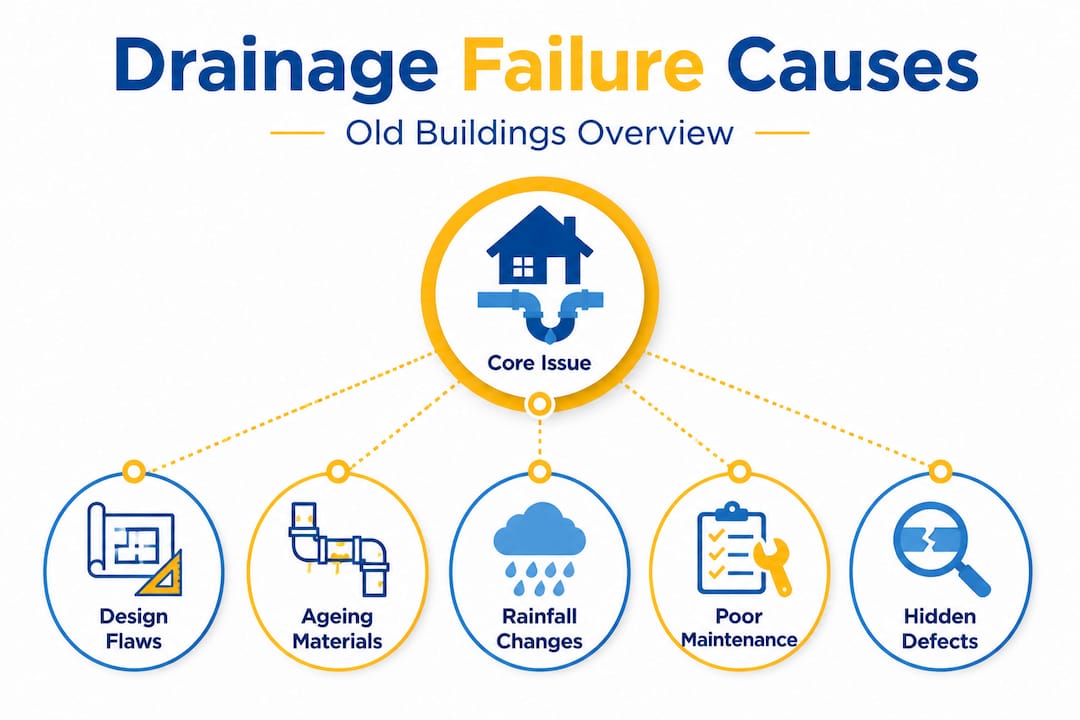
It is tempting to blame every drainage problem on the simple fact that a building is old. But that framing misses the real story. Drainage systems in older Southampton properties typically fall into two distinct categories: below-ground foul drainage, which carries wastewater away from toilets, sinks, and baths, and rainwater drainage, which manages roof run-off through gutters, downpipes, and surface gullies. Each category fails for different reasons, and treating them as one problem leads to wasted effort.
Below-ground foul drainage failures are strongly tied to surcharge and backflow risk during heavy rainfall events. When the public sewer fills up and cannot accept more flow, water is forced backwards through the private drainage network. Properties without anti-flood valves or sump pumping systems are completely exposed. Older buildings were simply not designed with these protections in mind, and many have never been retrofitted.
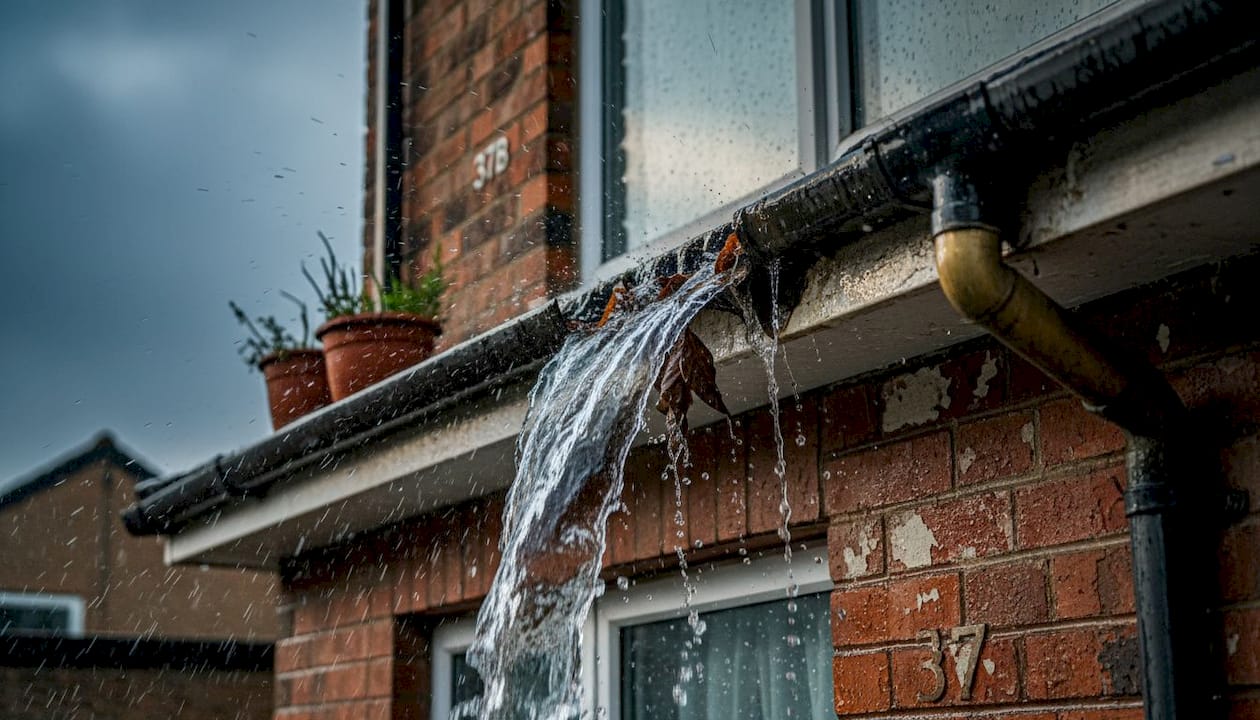
On the rainwater side, deluge-style rainfall events now regularly exceed the original design capacity of gutters and downpipes, even when those systems are perfectly intact and clear of blockages. The drainage system is not broken. It is just undersized for today’s weather.
The four root causes of drainage failure in older properties:
- System undersizing: Original pipe diameters and flow rates were calculated for rainfall patterns that no longer reflect reality
- Age-related wear: Decades of ground movement, temperature cycling, and chemical exposure weaken pipe joints and materials
- Maintenance gaps: Blocked gullies, collapsed inspection chambers, and overgrown drain routes go unnoticed until failure occurs
- Extreme weather: Short, intense rainfall events overwhelm both surface water and foul drainage capacity simultaneously
Understanding which of these is driving your problem is the critical first step, as the drainage failure steps you need to take will differ significantly depending on the root cause.
| Drainage type | Common failure trigger | Typical symptom |
|---|---|---|
| Foul/below-ground | Sewer surcharge, backflow | Basement flooding, rising damp, bad odours |
| Rainwater/surface | Capacity exceeded, blockage | Overflowing gutters, pooling water, soaked walls |
| Combined | Both triggers active together | Widespread flooding, repeated incidents |
How modern rainfall patterns overwhelm old systems
Understanding these core failures, it is vital to see how today’s climate is creating new challenges for traditional drainage layouts. When a Victorian terraced house in Southampton was built, its gutters and downpipes were sized according to the rainfall patterns of the time. Those calculations assumed relatively steady, moderate rain spread over extended periods.
What we get now is fundamentally different. Short, intense downpours, sometimes dropping 20mm of rain in under an hour, push enormous volumes of water into drainage systems in a fraction of the time those systems were designed to handle. As documented research confirms, historic rainwater systems fail not because they have deteriorated, but because deluge patterns can exceed a perfectly intact system’s capacity. This is a crucial distinction. You can clean every gutter, replace every downpipe, and still watch water pour over the fascia during a storm because the pipe diameter is simply too small for the volume arriving.
“Even a well-maintained historic rainwater system can be overwhelmed by a single intense rainfall event, because the original design never anticipated today’s extreme weather patterns.”
Consider a typical Southampton terrace with a 100mm diameter downpipe serving a large rear roof slope. In moderate rain, it copes comfortably. In a summer cloudburst delivering 30mm of rain in 45 minutes, that same downpipe faces flow rates it was never engineered to carry. The result is water sheeting across the roof, finding gaps around flashings, and penetrating the structure, creating interior damp that looks like a roof leak or a plumbing failure but is actually a drainage capacity problem.
Understanding surface water drain behaviour is particularly important for Southampton properties because the city’s mix of historic terracing, clay subsoils, and relatively high annual rainfall creates especially challenging conditions.
Pro Tip: Watch your gutters during the first five minutes of a heavy downpour. If water is overflowing at the corners or mid-span before any blockage is visible, your system is capacity-limited, not just dirty. That tells you the fix requires upsizing, not just cleaning.
Design flaws, ageing materials, and hidden defects
While the weather stresses old systems, flaws in design and materials make some problems inevitable without thorough intervention. Southampton’s older housing stock, particularly properties built between 1870 and 1960, relies heavily on clay-vitrified pipes, lead-sealed joints, and brick-built inspection chambers. Each of these materials has a finite lifespan and specific failure patterns.
The most common technical weaknesses in historic drainage systems:
- Clay pipes that have become brittle and fractured after decades of ground movement
- Socketed joints that have separated due to differential settlement
- Root ingress through cracked joints, particularly from trees planted after the drainage was laid
- Outfall connections that no longer align with the public sewer due to ground shift
- Inspection chambers built from brick that has spalled and partially collapsed internally
The failure modes follow a recognisable sequence:
- Structural collapse: Pipe walls fracture under ground load or root pressure, reducing bore diameter and flow capacity
- Root ingress: Fine roots enter through cracked joints and form dense mats that catch debris and cause persistent blockages
- Offset joints: Ground movement causes pipe sections to misalign, creating a physical step that catches solids and restricts flow
- Material decay: Lead-caulked joints, mortar-lined chambers, and bitumen-coated pipes break down chemically, releasing debris into the flow
The critical point, and one that many repair contractors overlook, is that drainage solutions must be matched to the failure mode rather than simply treating visible symptoms. Clearing a root blockage without addressing the crack that allowed root entry means the problem returns within months. Sealing a chamber wall without investigating what is causing damp on the inside wastes both time and money.
Common causes of blocked drains in older properties are frequently misdiagnosed because surface symptoms such as slow drainage or localised damp can have multiple underlying causes. A CCTV camera survey that traverses the full length of the drain run is the only reliable method for establishing exactly what is happening below ground. Dye testing, where coloured water is introduced at one point and tracked to its outlet, can confirm unexpected connections or cross-contamination between surface water and foul systems.
Pro Tip: Do not confuse rising damp with drainage failure. If damp appears at low level on a wall shortly after heavy rain but clears within 48 hours, the source is very likely external surface water or a drainage issue rather than classic rising damp. A drainage survey will confirm or rule it out far more reliably than a damp meter reading alone.
Why regular maintenance and tailored solutions matter
Addressing material and design flaws is only half the picture. Proactive, expert-led maintenance is essential for long-term reliability, especially in Southampton where the combination of historic building stock and increasingly unpredictable weather creates a high-risk environment.
Effective drainage resilience is maintenance-led and system-wide, as Historic England recommends, involving regular checks of gutters, ensuring external ground levels slope away from the building, and monitoring for blockages in neighbouring watercourses. That last point is often overlooked entirely.
Recommended maintenance steps after any significant rainfall event:
- Check gutters and downpipes for debris accumulation and ensure outlets are clear
- Inspect gully gratings at ground level for leaf litter, silt, and compacted debris
- Confirm external ground levels still slope away from the building’s foundations
- Check the condition of any inspection chamber lids and surrounding brickwork
- Note whether any neighbouring properties have overgrown drainage routes that might back up onto yours
One factor that surprises many property managers is how much neighbouring properties’ drainage behaviour affects your own risk. If the property next door has a blocked soakaway or a collapsed gutter that discharges directly onto shared hardstanding, that additional volume enters your drainage network too. You can maintain your own system immaculately and still experience problems driven by what is happening three metres away.
Smart prevention habits make a measurable difference over time, and investing in annual professional checks is considerably cheaper than emergency call-outs following a flood event. For optimising home drainage in older Southampton properties, separating your surface water maintenance routine from your foul drainage checks is genuinely good practice because the warning signs, the risks, and the correct interventions are different for each.
Pro Tip: Schedule gutter and downpipe checks in late autumn after leaf fall and again in early spring before the wetter season begins. Twice-yearly checks catch the most common blockage cycles before they cause structural damage.
Matching solution to the failure: diagnosis before repair
To ensure repairs actually solve the right problem, it is vital to match diagnosis and intervention methodically. Generic repairs in old buildings are a false economy. Spending money on jetting a drain that actually needs relining, or installing an anti-flood valve on a system that has a fractured pipe upstream, does not fix anything. It just delays the inevitable while the real damage continues.
The correct process follows four clear steps:
- Inspect: Carry out a visual check of all accessible drainage components, including gutter outlets, gully gratings, inspection chambers, and any visible pipe runs
- Diagnose: Use camera inspection surveys for below-ground pipes and dye testing to trace surface water routes and identify cross-connections
- Targeted fix: Apply the repair method that addresses the confirmed failure mode, whether that is relining a fractured pipe, clearing root ingress, upsizing a downpipe, or installing backflow prevention
- Maintenance plan: Establish a scheduled programme that reflects the specific vulnerabilities of the property rather than a generic annual check-box exercise
| Failure cause | Most effective repair |
|---|---|
| Fractured clay pipe | No-dig drain relining or patch lining |
| Root ingress | Root cutting followed by relining at entry point |
| Offset joint | Patch repair or section replacement |
| Sewer backflow | Anti-flood valve or sump pump installation |
| Undersized rainwater goods | Upsizing downpipes and gutters to modern capacity |
| Blocked surface gully | Jetting and grating replacement |
Understanding Southampton’s drainage infrastructure is particularly important when planning repairs because the city’s Victorian-era sewer network still serves many areas, and the interaction between private drainage and the public sewer affects which solutions are appropriate and which require prior consultation with Southern Water.
What most advice misses about drainage failures in old properties
Bringing together the evidence in this guide, there is one pattern that stands out as genuinely underappreciated, even by experienced contractors. Most guidance treats drainage as a single system and offers a single checklist. The reality is that rainwater drainage and foul drainage are separate systems with separate failure profiles, separate responsibilities, and separate correct responses.
The expert nuance for Southampton property managers is this: check and maintain rainwater goods and external ground levels as one discrete task, and manage foul sewer connections and backflow protection as a completely separate exercise. Conflating the two creates confusion about which contractor to call, which test is relevant, and which repair addresses which risk.
There is also a widely overlooked danger in partial solutions. Installing an anti-flood valve on a basement foul drain is excellent protection against backflow from the public sewer. But if that same basement also receives surface water ingress through a failed gully or cracked external wall, the anti-flood valve can actually trap surface water inside the property during a surcharge event, making flooding worse rather than better. This is the kind of system-level consequence that only becomes apparent when you look at rainwater and foul drainage together as interacting elements rather than isolated problems.
The honest approach is to develop a bespoke drainage plan for each property based on its specific construction period, pipe materials, ground conditions, and rainfall exposure. A Georgian townhouse in the old town and a 1930s semi in Bitterne have fundamentally different drainage profiles. Generic advice serves neither well.
Expert drainage solutions for Southampton’s older properties
If the issues covered in this guide sound familiar, you are not alone. Many Southampton homeowners and property managers are managing older buildings where the drainage system has never received the kind of structured, diagnosis-led attention it needs.

At blocked-drainssouthampton.co.uk/services, we specialise in exactly the kind of targeted, system-level drainage work that older Southampton properties require. From CCTV surveys that pinpoint the actual failure mode to no-dig relining, backflow protection, root removal, and full soakaway installations, every solution we offer starts with proper diagnosis rather than guesswork. We understand Southampton’s historic drainage infrastructure and the specific challenges it creates for properties across the city. Contact us to arrange a professional assessment and get a clear, costed plan that actually addresses the right problem.
Frequently asked questions
What’s the most common cause of drainage failure in old buildings?
The most common cause is a combination of undersized systems that were never designed for today’s rainfall patterns alongside age-related deterioration of pipe joints and materials. Neither factor alone tells the full story.
How can I check if my old building’s drainage is at risk from heavy rain?
Look for water backing up in gullies during storms, gutters overflowing mid-span before blockage is obvious, or basement damp appearing shortly after rain. Following Historic England’s guidance on post-rainfall checks is a practical starting point, and a CCTV survey will confirm any below-ground risks.
Is DIY maintenance enough to prevent major drainage failures?
Routine maintenance such as clearing gutters and gullies genuinely helps, but camera-based diagnosis is essential to detect fractured pipes, root ingress, offset joints, and backflow risks that visual checks cannot reach.
Do I need different checks for rainwater and foul drainage in my property?
Yes, absolutely. Rainwater goods and surface water routes require separate maintenance from foul drain connections and backflow protection, because the risks and correct interventions differ significantly between the two systems.
Recommended
- Solve drainage problems in older properties: 5 steps
- Solving drainage issues in historic Southampton properties
- Optimise your home drainage: blockage-free Southampton
- What is a combined drain? Essential guide for Southampton homes
- 5 Warning Signs You Need Sewer Repair (Before It Becomes a $20,000 Emergency)
- Step-by-step drain cleaning workflow for Maine homes