TL;DR:
- Many historic Southampton sewers can be repaired with modern, less invasive techniques.
- Early detection through inspections and surveys is crucial to prevent costly failures.
- Regular maintenance and proactive upgrades save money and protect properties from drainage problems.
Many Southampton homeowners assume that once a Victorian sewer starts causing trouble, there is little to be done short of a full and ruinously expensive replacement. That assumption is wrong, and it costs people money every year. Southampton’s historic drainage network is genuinely complex, shaped by centuries of urban growth, industrial heritage, and geography that no modern planner would choose. But recent investment, better diagnostic tools, and smarter maintenance approaches mean that even the most stubborn old-pipe problems can be managed effectively. This guide covers the causes of historic drainage failure, how to spot warning signs early, what a proper inspection involves, and which modern solutions actually work for older properties.
Table of Contents
- Understanding historic drainage problems in Southampton
- Common warning signs and risks of old drainage systems
- Evaluating your drainage: Inspections, surveys, and what to expect
- Modern solutions and ongoing maintenance for historic drainage
- Why swift action beats costly repairs: What most guides overlook
- Get professional drainage support for your property
- Frequently asked questions
Key Takeaways
| Point | Details |
|---|---|
| Historic drainage is fixable | Even Victorian systems can be improved with modern assessments and upgrades. |
| Warning signs need attention | Early symptoms like slow drains and smells can prevent costlier repairs later. |
| Regular surveys pay off | Proactive CCTV inspections and maintenance are more cost-effective than emergency fixes. |
| Professional support matters | Local drainage experts understand Southampton’s unique infrastructure and can offer targeted solutions. |
Understanding historic drainage problems in Southampton
Southampton’s drainage infrastructure tells the story of the city itself. Much of the network serving older residential streets and commercial districts dates to the Victorian era, when combined sewers were the standard approach. A combined sewer carries both foul waste and stormwater in the same pipe, which worked tolerably well when the city was smaller and rainfall patterns were more predictable. Today, with increased surface runoff from paved gardens and car parks, those same pipes are regularly overwhelmed.
Historic pipework in Southampton is typically made from glazed clay or early concrete, materials that crack, root-infiltrate, and corrode over decades. Properties built before 1950 are especially likely to have original drainage that has never been structurally upgraded. The Southampton drainage guide outlines how the city’s port geography and clay-heavy soils add further stress to underground pipework, accelerating joint failure and ground movement.
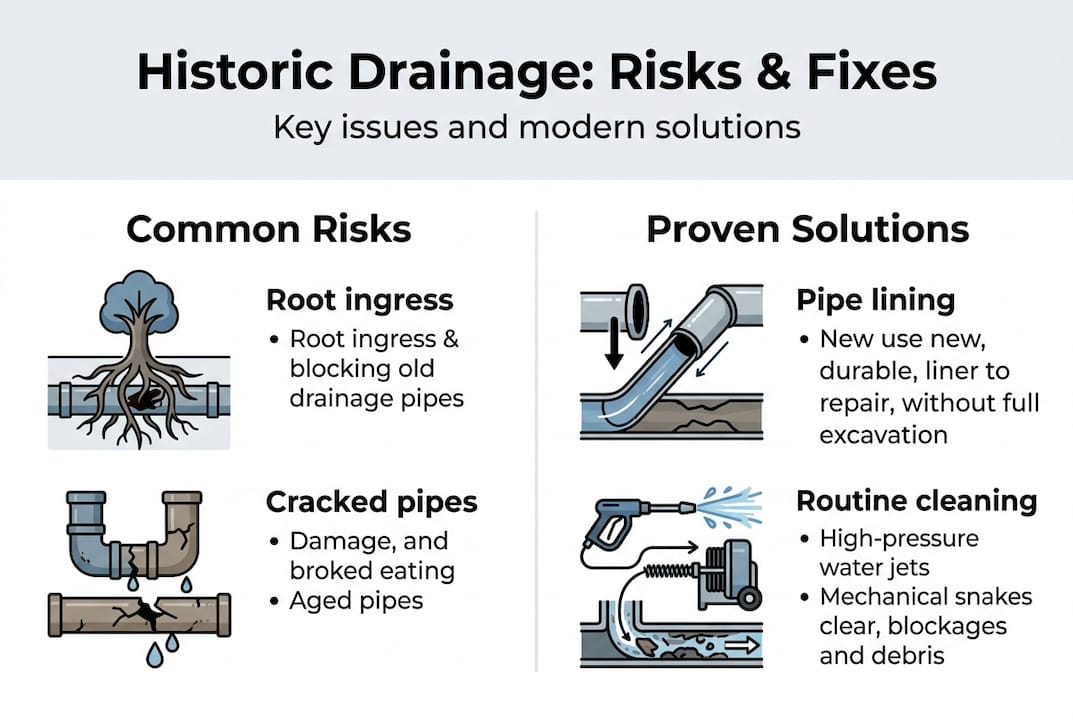
The scale of the problem is significant. £341M is committed for Hampshire and the Isle of Wight over five years, part of a £1.5 billion national investment plan that has already prevented over 700 storm overflows. That level of public investment reflects just how serious the ageing combined sewer problem has become across the region.
Common issues in properties with historic drainage:
- Slow or gurgling drains that worsen after rainfall
- Recurring blockages in the same section of pipework
- Sewer smells inside or outside the property
- Surface flooding in gardens or driveways during storms
- Damp patches on ground-floor walls or floors
- Structural movement near drain runs or inspection chambers
| Property type | Typical pipe age | Most common issue |
|---|---|---|
| Pre-1900 terraced house | 100+ years | Root infiltration, cracked clay |
| 1900 to 1950 semi-detached | 75 to 100 years | Joint failure, offset pipes |
| Victorian commercial premises | 100+ years | Combined sewer overload, collapse |
| Post-war housing estate | 50 to 75 years | Concrete deterioration, blockages |
Neighbourhoods such as Shirley, Freemantle, and the older parts of Bitterne are among those most likely to sit above the oldest sections of the network. If your property falls into any of the categories above, the risk of drainage problems is not a matter of if but when.
Common warning signs and risks of old drainage systems
Knowing the roots of these challenges makes it easier to spot signs of trouble early. The difficulty with historic drainage is that problems rarely announce themselves dramatically at first. Instead, they build quietly over months or years until a minor inconvenience becomes a genuine emergency.
How to spot drainage problems in older properties:
- Drains that empty slowly even when not visibly blocked
- A gurgling sound from toilets or sinks after flushing
- Persistent foul smells near inspection chambers or outside gullies
- Water pooling on paths or lawns after moderate rain
- Damp or efflorescence (white salt deposits) on lower walls
- Cracks appearing in walls or floors close to drain routes
Secondary symptoms are easy to misattribute. Damp on a ground-floor wall might be blamed on rising damp or a leaking radiator, when the real cause is a cracked drain running beneath the floor slab. Similarly, recurring mould in a ground-floor room can signal a slow drain leak long before any visible flooding occurs. Foundation movement near old drain runs is a serious structural risk that insurers are increasingly scrutinising.
“Old combined sewers were never designed for the volumes of stormwater they receive today. When Victorian sewers are overwhelmed, the consequences range from localised flooding to full combined sewer overflow events that affect entire streets.”
The insurance angle matters more than many owners realise. Repeated drainage-related claims can trigger policy exclusions or significant premium increases. Documenting regular maintenance and surveys is increasingly important for keeping cover in place. Understanding the common blocked drain causes that affect Southampton properties gives you a practical starting point for reducing risk.
Pro Tip: If you notice two or more of the warning signs listed above at the same time, do not treat them separately. Multiple simultaneous symptoms almost always point to a single underlying structural fault rather than several unrelated minor issues.
Evaluating your drainage: Inspections, surveys, and what to expect
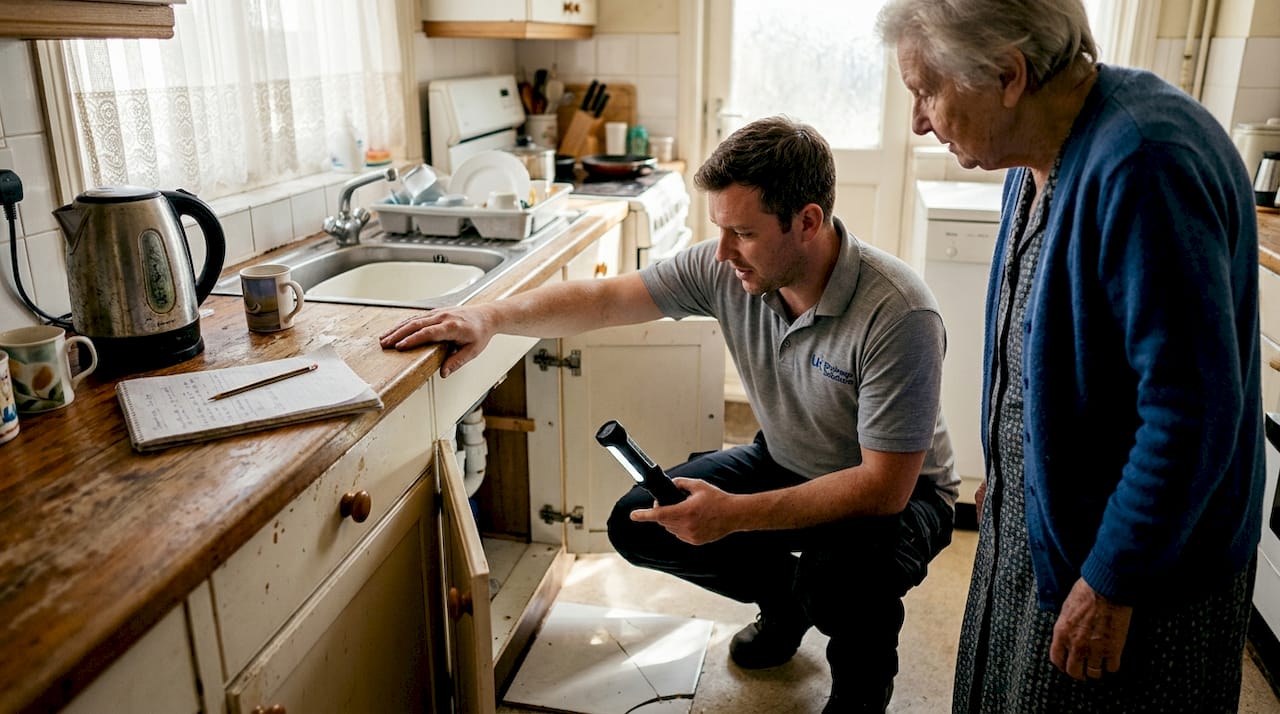
Once warning signs appear, prompt and thorough evaluation is your next move. Many property owners make the mistake of calling a drain cleaner when what they actually need is a drain surveyor. Clearing a blockage in a structurally compromised pipe is a temporary fix at best.
| Inspection type | What it reveals | Best suited for |
|---|---|---|
| Visual inspection | Surface condition, obvious blockages | Initial check, low-cost screening |
| CCTV drain survey | Internal pipe condition, cracks, root ingress, offsets | Definitive diagnosis of historic systems |
| Dye testing | Flow paths, cross-connections, soakaway performance | Tracing drainage routes in older properties |
A professional surveyor examining historic pipework looks beyond blockages. They assess pipe material and wall thickness, the condition of joints (which are the most vulnerable point in clay pipe systems), evidence of root infiltration, any pipe offset caused by ground movement, and the general gradient of the run. Victorian pipes were often laid by hand to approximate gradients, and even small errors compound over time.
Quick-action checklist for property owners and managers:
- Book a CCTV survey if the property is pre-1960 and has never had one
- Check inspection chamber covers for signs of cracking or settlement
- Clear surface gullies of leaves and debris before autumn
- Note the location of all drain runs on a site plan if possible
- Ask your insurer whether drainage surveys affect your cover terms
The benefits of a professional drain survey extend well beyond fault-finding. Survey reports provide documented evidence of condition, which is valuable during property sales, lease renewals, and insurance renewals. Ongoing infrastructure investment in the public network is improving conditions, but the private drains on your land remain your responsibility entirely.
Regular surveys also create a baseline. A survey carried out today gives you a reference point for comparison in two or three years, making it far easier to identify whether a problem is stable or deteriorating.
Modern solutions and ongoing maintenance for historic drainage
With a proper inspection, the next question is: what can actually be done once issues are found? The good news is that the range of available solutions has expanded considerably, and full pipe replacement is rarely the only or even the best option.
Most effective repair and upgrade strategies for old drainage:
- Pipe lining (CIPP): A resin-impregnated liner is inserted and cured in place, creating a new pipe within the old one without excavation
- Patch repair: Targeted resin patches fix isolated cracks or joint failures without disturbing the whole run
- Root removal and treatment: Mechanical cutting combined with root-inhibiting treatment prevents regrowth in cracked clay pipes
- Targeted section replacement: Where a short section has collapsed, open excavation of just that section is far cheaper than full replacement
- Backwater valves: Fitted to prevent sewer flooding from backing up into the property during storm events
- Remote monitoring sensors: Low-cost sensors in inspection chambers alert you to rising water levels before overflow occurs
Ongoing maintenance is where most property owners underinvest. A single annual visit from a professional drainage team, covering high-pressure jetting, root clearing, and a visual check of chambers, costs a fraction of what an emergency callout or structural repair will set you back. The drainage solutions available for old pipes in Southampton show just how much can be achieved without major disruption.
Pro Tip: Ask your drainage contractor about an annual maintenance plan rather than booking one-off visits. Planned works are always cheaper than reactive callouts, and a good plan lets you spread the cost predictably across the year.
Southern Water’s ongoing infrastructure improvements demonstrate that even the oldest systems can be upgraded and protected with the right investment and approach. The same principle applies to your private drains. You can explore the full range of drainage maintenance services available locally to find the right fit for your property.
Why swift action beats costly repairs: What most guides overlook
Most drainage guides focus on what to do after something goes wrong. That framing is understandable but ultimately backwards. In our experience working with Southampton properties, the owners and managers who spend the least on drainage over the long term are those who act early and act regularly, not those who wait for a crisis and then spend heavily to resolve it.
Reactive repairs are almost always more expensive than planned maintenance, sometimes by a factor of five or ten. A pipe lining job carried out on a stable but ageing pipe costs significantly less than the same job carried out after a partial collapse has caused ground subsidence or internal flooding. The expert approach used by local drainage specialists in Southampton reflects this reality: prevention is less dramatic than emergency response, but it is far more effective.
The uncomfortable truth is that most property damage from drainage failure was avoidable. Not because the pipes were not old, but because the signs were there and nobody acted on them.
Get professional drainage support for your property
If you manage or own a property in Southampton with historic drainage, the worst thing you can do is wait. Problems in old systems rarely stabilise on their own.
At blocked-drainssouthampton.co.uk, we specialise in exactly the kind of complex, historic drainage challenges that Southampton properties present. From CCTV surveys and pipe lining through to root removal and emergency response, our team brings genuine local knowledge to every job. Browse our full range of drainage services, read the essential guide to Southampton drainage infrastructure, or contact our team today to book a survey or get immediate advice. Protecting your property starts with a single call.
Frequently asked questions
What are the main causes of drainage problems in historic Southampton homes?
The main causes are ageing pipe materials, combined sewers overloaded by modern rainfall, and ground movement around old foundations. Victorian sewers overwhelmed by stormwater are a particularly well-documented regional issue.
How often should I arrange a drain survey for an older property?
A CCTV drain survey is advised every one to two years for at-risk or historic properties to catch problems early before they escalate into costly structural repairs.
Are there affordable long-term solutions for historic drainage issues?
Yes, techniques such as pipe lining and regular professional maintenance can keep old systems working well without the cost and disruption of full pipe replacement.
How much investment is being made in fixing Southampton’s old drainage systems?
£341M is committed for Hampshire and the Isle of Wight over five years to reduce storm overflows and upgrade the ageing combined sewer network across the region.