TL;DR:
- Poor drainage causes costly damage and legal risks for Southampton property owners due to aging infrastructure and complex site conditions. Effective systems manage water at its source using layered features like SuDS, proper gradients, and regular maintenance; proactive inspection and management are essential to prevent failures. Consulting drainage professionals and implementing comprehensive plans help ensure long-term performance and adapt to changing ground conditions.
Poor drainage is one of the most expensive problems a Southampton property owner can face. A flooded basement, a waterlogged garden, or a blocked commercial drain can result in thousands of pounds of damage and significant legal exposure if the system fails to meet regulatory standards. Southampton’s ageing infrastructure, its mix of Victorian terraces, modern commercial estates, and coastal geography make drainage both more complex and more critical than in many other UK cities. This guide breaks down exactly what makes a drainage system effective, from foundational design principles to a practical checklist you can use to audit your own property right now.
Table of Contents
- Core principles of effective drainage system design
- Surface water management: SuDS and the ‘management train’
- Critical mechanics: gradients, outlets, and operational details
- Maintenance, adoption and ongoing system management
- Practical checklist: effective drainage features for Southampton properties
- Why most drainage failures are rooted in overlooked details
- Expert drainage support for Southampton homes and businesses
- Frequently asked questions
Key Takeaways
| Point | Details |
|---|---|
| Natural water management | Designs should control water at or near its source and use SuDS features. |
| Layered system approach | Effective drainage relies on a series of integrated features, not a single drain. |
| Correct installation details | Pipe gradients, outlet choices, and access points are vital for reliability. |
| Regular maintenance duties | Success depends on setting up inspections and knowing owner responsibilities. |
| Actionable checklist | Property owners should map, test, design, and plan maintenance for robust drainage. |
Core principles of effective drainage system design
Before looking at specific features, it helps to understand what separates a well-designed drainage system from one that simply shifts water from one place to another and hopes for the best.
The fundamental goal is to manage water where it falls, rather than rushing it into pipes and sending it downstream. Effective drainage in the UK should follow a natural approach, managing runoff at or near its source rather than relying purely on underground pipes to convey water away quickly. In practice, this means giving water somewhere to go before it becomes a problem, using the landscape itself to slow, filter, and absorb flow.
The core principles that underpin any effective system include:
- Source control first: Intercept rainwater at the point of impact, whether that is on a roof, a paved driveway, or a flat commercial roof.
- A layered approach: Combine multiple features in sequence rather than depending on a single pipe or soakaway.
- Regulatory compliance: Systems must meet Building Regulations Part H and relevant local planning requirements.
- Accessible inspection points: Every system needs chambers or access points at key junctions to allow cleaning and camera inspection.
- Seasonal adaptability: Clay soils in parts of Southampton swell in winter, reducing infiltration capacity. Design must account for this.
For older Southampton properties in particular, the drainage infrastructure guide for Southampton homes is worth reviewing before committing to any design or upgrade.
Pro Tip: Never assume a drainage system is working just because it is not visibly flooded. Slow drainage, persistent damp patches, and subtle subsidence are early warning signs that a system is under stress long before a failure becomes obvious.
Surface water management: SuDS and the ‘management train’
Surface water, the rain that falls on roofs, paths, driveways, and gardens, is the single biggest challenge for most Southampton properties. This is where Sustainable Drainage Systems (SuDS) come in, and understanding how they work in practice is the key to making smart decisions.
The SuDS concept is built around what engineers call a “management train.” Rather than a single drain doing all the work, SuDS work as a management train of multiple features that control flow rates and volumes, whilst also delivering water quality, biodiversity, and amenity benefits. Think of it as a relay race for water: each feature handles part of the journey, reducing the burden on the next one in line.
Here are the core components of a well-designed SuDS management train, in the order water typically encounters them:
- Permeable surfaces: Driveways and paths laid with permeable block paving or gravel allow water to soak through rather than run off. This is often the simplest intervention for domestic properties.
- Filter strips and swales: Shallow, vegetated channels that slow water and filter out sediment before it reaches the next feature. Well-suited to detached properties with garden space.
- Filter drains: Gravel-filled trenches alongside roads or paths that capture runoff and allow gradual infiltration into the ground.
- Soakaways: Underground chambers or crates that hold water temporarily and allow it to percolate into the soil. Southampton’s varied geology means a percolation test is essential before installing one.
- Retention ponds and basins: More common in commercial and new-build developments, these store larger volumes and release water slowly.
You can explore drainage solutions relevant to Southampton properties across different scales and budgets to understand which combination suits your site.
| SuDS feature | Best for | Key benefit | Maintenance need |
|---|---|---|---|
| Permeable paving | Driveways, car parks | Reduces runoff at source | Annual jet wash |
| Swale | Gardens, open areas | Slows and filters water | Seasonal cutting |
| Soakaway | Domestic properties | Infiltrates water to ground | 5-year inspection |
| Filter drain | Roads and paths | Captures and slows runoff | Annual inspection |
| Retention basin | Commercial sites | Stores large volumes | Quarterly checks |
For homeowners dealing with surface water pooling near the house, exploring surface water drain options in Southampton is a practical starting point.
“SuDS are intended to work as a management train of multiple features to control flow rates and volumes, and deliver water quality, biodiversity, and amenity benefits.” National Standards for SuDS (GOV.UK)
Critical mechanics: gradients, outlets, and operational details
Even the most thoughtfully designed drainage layout will fail if the pipe gradients are wrong. This is one of the most overlooked aspects of drainage installation and one of the most common causes of recurring blockages.
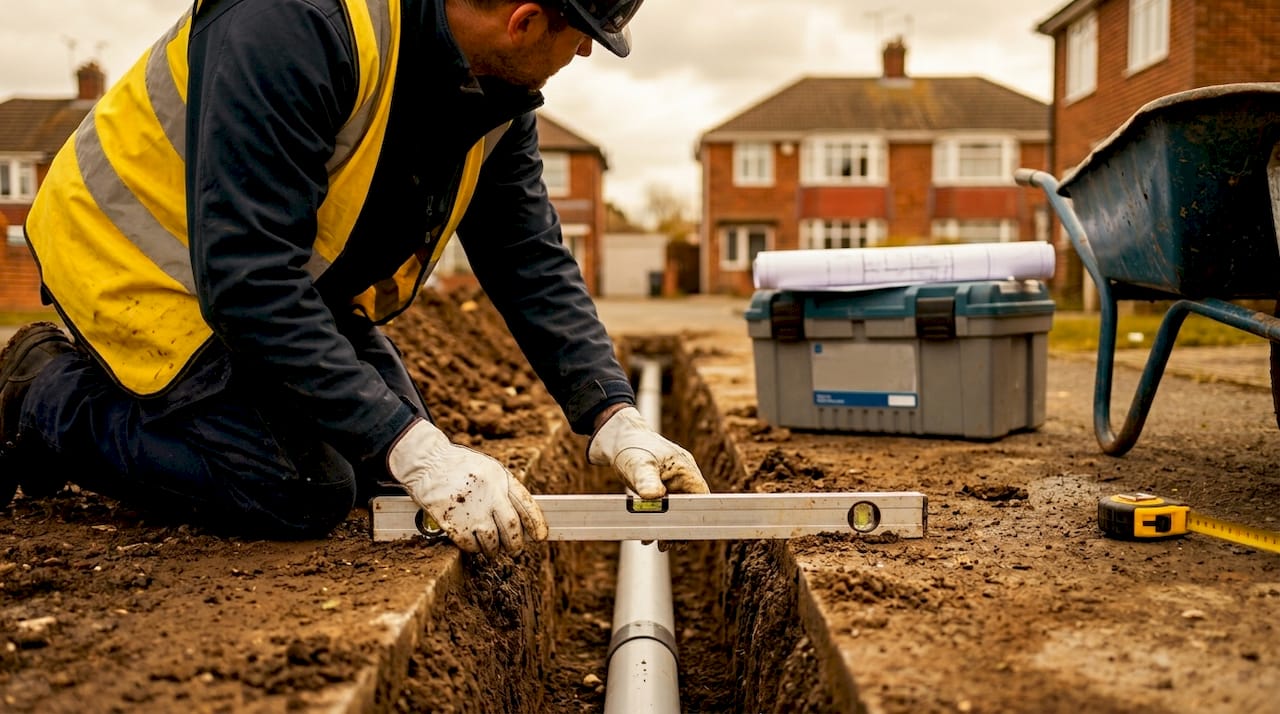
Correct gradients are essential for gravity foul and surface water sewers to avoid stagnation and blockages. Without the right fall, water slows inside the pipe, solids settle, and blockages become inevitable. This is known as “self-cleansing velocity”: the minimum speed water needs to travel through a pipe to keep sediment moving.
| Pipe diameter | Minimum gradient | Maximum practical gradient |
|---|---|---|
| 75mm | 1 in 40 | 1 in 10 |
| 100mm | 1 in 80 | 1 in 10 |
| 150mm | 1 in 150 | 1 in 10 |
| 225mm | 1 in 225 | 1 in 10 |
Beyond gradients, outlet selection matters enormously. The right outlet depends on what is available at your property:
- Soakaway: Suitable where soil permeability allows and there is sufficient distance from the building and boundaries.
- Ditch or stream: Requires checking local byelaws and potentially obtaining consent from the Environment Agency or local authority.
- Surface water sewer: Connection may be restricted. RHS guidance on garden drainage stresses checking byelaws that may restrict connections to sewers or storm drains before committing to any outlet route.
- Combined sewer: Generally avoided for surface water in modern systems due to overloading risk.
Diagnosing an existing drainage problem? Look for these symptoms:
- Puddling after moderate rain that takes more than two hours to clear
- Gutters overflowing despite not being blocked
- Slow drainage from multiple gullies simultaneously
- Damp at the base of walls or in cellars following wet weather
- Visible wet patches in gardens even during dry spells
For drainage problems in older properties, Southampton has specific challenges: Victorian-era combined sewers, clay soils in some districts, and ground movement near the waterfront all contribute to a higher incidence of gradient loss over time.
Pro Tip: If your property sits at the base of a slope or below road level, gravity drainage may not be possible to the main sewer. In this situation, a pump station with a float switch is often the only reliable long-term solution. Get this assessed by an engineer before laying any pipework.
Maintenance, adoption and ongoing system management
Designing and installing a drainage system is only half the job. What determines whether it actually performs over the long term is how it is maintained.
The national SuDS standards include explicit maintenance and adoption responsibilities. If a SuDS system serves a single property, the owner is responsible for its upkeep. Where a system serves multiple properties, an appropriate authority or management body must adopt it and arrange future maintenance. This distinction matters enormously for new-build estates and commercial parks in Southampton.
For commercial property owners, proactive drainage management through scheduled inspection and cleaning is strongly recommended rather than waiting for a flood or blockage to prompt action. Reactive management is consistently more expensive and more disruptive.
Here is a practical maintenance schedule for both residential and commercial properties:
- Monthly: Clear leaves and debris from gullies, gratings, and downpipe outlets. Check that soakaway access covers are secure.
- Quarterly: Inspect all visible inspection chambers for signs of sediment build-up, root intrusion, or cracking. Flush gullies with water.
- Bi-annually: Arrange a professional jet-wash of key pipe runs, especially those serving commercial kitchens, car parks, or high-traffic areas.
- Annually: Commission a CCTV drain survey to assess pipe condition, check for root ingress, and confirm gradients are intact.
- After storms: Carry out a visual inspection of all SuDS features (swales, soakaways, permeable surfaces) and clear any blockages or sediment deposits within 48 hours.
For commercial drainage, explore best practices specifically relevant to Southampton’s business districts, where high footfall and food waste create particular challenges.
The consequences of poor maintenance are well-documented. A commercial drain blockage can cost significantly more in emergency call-out fees, business disruption, and potential regulatory penalties than a year’s worth of preventive maintenance. For residential owners, neglected inspection chambers can cause drain collapse, which frequently results in subsidence claims that run into tens of thousands of pounds. Professional drain survey inspections are a worthwhile investment before purchasing any older property.
Key things to document as part of ongoing management:
- Dates and results of all inspections
- Records of any cleaning or jetting carried out
- Any repairs made, including pipe relining or root removal
- Photographic records from CCTV surveys
- Copies of adoption agreements if the system serves multiple properties
Practical checklist: effective drainage features for Southampton properties
The following checklist combines design, installation, and management steps into a single audit framework. Work through it in order, whether you are planning a new system, upgrading an existing one, or simply reviewing what you have.
The national SuDS framework recommends a four-stage approach for property owners: map how water reaches problem areas, confirm whether infiltration is feasible via soil testing, design a SuDS management train that controls rate and volume and provides treatment, and set up maintenance and adoption arrangements from the outset.
- Map your water sources: Identify all roof drainage, hard-standing areas, and surface routes. Note where water pools or flows during heavy rain.
- Carry out a percolation test: Dig a test pit and measure how fast water drains away. This determines whether a soakaway is viable on your site.
- Check your current system: Locate all inspection chambers and confirm whether your drainage is separate (foul and surface water in different pipes) or combined.
- Assess pipe condition: Commission a CCTV survey of any pipes older than 20 years, or if you have seen any of the symptoms listed earlier.
- Select your SuDS features: Based on available space and soil type, design a management train starting with source control (permeable surfaces or water butts) and working through to the final outlet.
- Confirm gradients: Ensure all new or replaced pipework achieves the minimum fall for the pipe diameter in use.
- Install accessible inspection points: Every change in direction, change in gradient, and pipe junction needs an accessible inspection chamber.
- Set up a maintenance schedule: Document who is responsible, what tasks need doing, and at what intervals. Review this annually.
- Check planning and legal compliance: Confirm that any connections to ditches, streams, or sewers meet local authority and Environment Agency requirements.
- Get expert input: For any system serving more than one property, or where subsidence, flooding history, or complex soil conditions are involved, consult local drainage experts in Southampton before finalising your design.
Pro Tip: Start the checklist at step one even if you think your drainage is fine. Most drainage failures we encounter in Southampton were preventable had the owner simply known where their water was coming from and where it was supposed to go.
For a deeper look at optimising your home drainage, there are Southampton-specific guides covering everything from downpipe diverters to full soakaway replacements.
Why most drainage failures are rooted in overlooked details
After years of working on drainage systems across Southampton, a clear pattern emerges. Property owners focus on the visible: a new gully, a soakaway installation, a repaved driveway. What they consistently underestimate is the invisible infrastructure that determines whether all of that investment actually works.
Gradients shift over decades as ground settles. Inspection chambers fill with silt and are never opened. Soakaways installed fifteen years ago are now surrounded by compacted, altered soil that no longer absorbs water at its original rate. These are not dramatic failures. They are quiet, incremental changes that accumulate until one heavy rainfall turns a manageable situation into an emergency.
The uncomfortable truth is that most drainage failures we attend are not the result of wrong products or poor installation. They are the result of no maintenance programme and no regular inspection. A CCTV survey costs a fraction of what a collapsed drain or a flooded ground floor costs to fix.
There is also a mindset issue. Homeowners treat drainage reactively, calling for help when water is already inside the building. Commercial managers often do the same, only acting when a drain failure creates a health and safety incident or a business interruption claim. Shifting to a proactive approach, one that treats drainage as ongoing infrastructure rather than a one-time installation, is the single biggest change that improves long-term outcomes.
Protecting Southampton homes from flooding is not only about what is installed. It is about whether that installation is monitored, maintained, and adapted as conditions change around it.
Expert drainage support for Southampton homes and businesses
Taking the time to understand how your drainage system should work is genuinely valuable, but knowing what to do and actually implementing it are two different things.
Whether you are a homeowner who has spotted pooling water near your foundations, or a commercial property manager who needs to put a compliant maintenance programme in place, professional support makes the difference between a system that works and one that costs you money year after year. Our team at Blocked Drains Southampton covers everything from CCTV surveys and soakaway installation to emergency blockage clearance and full system design. Explore our full range of drainage services to find out how we can help, or revisit the comprehensive drainage infrastructure guide to build on what you have learned here.
Frequently asked questions
What are the most important features of a home drainage system?
The most important features are effective water management at source, correct pipe gradients, accessible inspection points, and a regular maintenance arrangement. Effective drainage should use a management train of features rather than relying on a single pipe route.
How do I know if my property has poor drainage?
Signs include puddling after rain that takes more than a couple of hours to clear, slow run-off from hard surfaces, and water backing up near gullies or inspection chambers. Identifying poor drainage through observation after moderate rainfall is the most reliable first diagnostic step.
Who is responsible for maintaining drainage features on my property?
If the drainage serves only your property, you are responsible for its upkeep and ongoing performance. Where a system serves multiple properties, an appropriate authority or management body must formally adopt and maintain it.
What should I do if water will not drain due to a lack of gradient?
Where gravity drainage is not achievable, electric pumps with float switches are the standard solution for moving water away from the property. This should be assessed by a qualified drainage engineer before any excavation begins.
How often should I inspect or clean my commercial drainage system?
Scheduled inspections and cleaning should happen at least seasonally, with additional checks following storms, high-footfall events, or periods of heavy debris accumulation. Documented records of every inspection are strongly advisable.