TL;DR:
- Adhering to MSCC5 standards and obtaining NADC certification ensures compliant and accepted drain surveys.
- Using advanced technology like HD cameras, inclinometers, and geotagging improves survey accuracy and data integrity.
- Properly timed, structured surveys with detailed reporting reduce costly remedial work and project delays.
A single drainage mistake can cost a construction project thousands of pounds, delay completion, and expose contractors to liability under CDM regulations. For those working across Southampton, where pre/post-construction surveys are essential for mapping unforeseen underground risks, getting drain surveys right is not optional. This guide gives you actionable, expert-backed tips on standards, technology, project integration, and reporting that will sharpen your practice and protect your bottom line on every Southampton site.
Table of Contents
- Understand drain survey standards and compliance
- Choose and use advanced drain survey technology
- Integrate surveys into Southampton project planning
- Produce actionable, structured reports the right way
- What most contractors miss about drain survey success
- Partner with experts for reliable drain surveys in Southampton
- Frequently asked questions
Key Takeaways
| Point | Details |
|---|---|
| Follow MSCC5 codes | Always use the MSCC5 coding system for survey credibility and compliance. |
| Invest in modern tools | Choose HD cameras, AI-assisted software, inclinometer and geotagging to meet professional standards. |
| Time surveys for project safety | Integrate drain surveys at key stages to spot risks before they become costly mistakes. |
| Deliver clear, structured reports | Provide clients with comprehensive, jargon-free reports that support follow-up decisions. |
Understand drain survey standards and compliance
Every legitimate drain survey in the UK runs on a single common language: the WRc MSCC5 standard. Water companies, building control officers, and local authorities all expect MSCC5-coded reports, and they will refuse non-compliant submissions. That refusal does not just cause delays — it can invalidate your survey entirely, sending you back to square one at your own cost.
MSCC5 works through a precise system of defect codes that leaves no room for ambiguity. Each code describes a specific condition found inside the pipe:
- RM — Root mass, indicating significant root intrusion that restricts flow
- CC — Circumferential crack, showing structural damage running around the pipe’s circumference
- FJ — Faulty joint, meaning the pipe connection has failed or shifted
- DF — Deformation, where the pipe has lost its original shape under load
- OS — Obstruction, a partial or full blockage material present in the line
These codes standardise findings so that any qualified engineer, building control officer, or water company inspector can read the report without needing to contact you for clarification. The code is the finding.
“Structured defect coding under MSCC5 is not a box-ticking exercise — it is the only format that guarantees your survey findings will be accepted, acted upon, and archived correctly by all parties.”
Beyond the coding itself, the people conducting and overseeing surveys must hold the right qualifications. The National Association of Drainage Contractors awards the NADC certification, and its OS19X qualification is the recognised mark of competence for on-site drain survey operatives. Insurers increasingly require NADC accreditation when drainage work forms part of a larger construction contract. Choosing a team without it creates a gap in your project’s insurance cover.
For Southampton-specific compliance requirements, reviewing Southampton drain survey standards will clarify any local obligations that sit alongside national frameworks.
Pro Tip: Always request a copy of the surveyor’s NADC certificate before they start work. A legitimate contractor will provide this without hesitation, and it protects you if the report is later challenged.
Choose and use advanced drain survey technology
Compliant standards mean nothing without the technology to gather the data they demand. The minimum acceptable camera specification for a CCTV drain survey in 2026 is 1080p HD video resolution. Anything below that fails to capture the fine crack detail and joint displacement that MSCC5 defect coding requires.
But resolution is only part of the picture. Look for these core capabilities in any survey system:
- Integrated inclinometer to record pipe gradient in real time, flagging falls that cause standing water and silt build-up
- Geotagging on all images and video segments, linking each finding to its precise location
- Laser profiling for pipes above 150mm diameter where deformation might not be visually obvious
- Pan-and-tilt camera head for accurate inspection at junctions and lateral connections
The MSCC5 data integrity guidance is explicit: reports must include HD snapshots, inclinometer readings, and geotagged metadata in an XML structure to satisfy interoperability requirements. Without XML output, your data cannot be imported into the client’s asset management systems or verified by a water company.
| Feature | Minimum requirement | Best practice |
|---|---|---|
| Camera resolution | 1080p HD | 4K with HDR |
| Gradient measurement | Integrated inclinometer | Live digital readout |
| Location tagging | GPS geotagging | Sub-metre accuracy GNSS |
| Report format | XML export | XML plus CSV and PDF |
| AI coding assist | Optional | Human-verified mandatory |
Software such as WinCan VX is the industry-standard platform for compiling these outputs into structured, compliant reports. It integrates directly with MSCC5 coding libraries and produces the XML files water companies require. AI-assisted coding within such platforms can speed up defect identification by up to 50%, but every AI suggestion must be reviewed and confirmed by an OS19X-qualified human surveyor before the report is signed off.
For contractors wanting to understand how drainage technology upgrades are changing site outcomes, or reviewing commercial drainage best practices across larger developments, these resources show how modern tools translate directly into fewer project delays.
Integrate surveys into Southampton project planning
Knowing the standards and having the right equipment only delivers value when surveys happen at the correct project stage. Many contractors commission a single survey and assume that covers them. It rarely does.
Here is the recommended sequence for most Southampton construction and development projects:
- Pre-purchase survey — Confirm what you are buying. Identify existing defects before contracts exchange.
- Pre-construction survey — Establish baseline condition. Map pipe layout, ownership boundaries, depth, direction, material, and flow direction before any groundworks begin.
- During-construction check — If groundworks alter drainage paths or load-bearing conditions near pipes, a mid-project survey catches damage early.
- Post-construction survey — Verify no damage was caused, confirm new connections are compliant, and produce the handover documentation.
- Pre-sale or pre-let survey — Protects the client and provides a clean record for conveyancers and mortgage lenders.
Following RIBA guidance, these pre and post-construction surveys are essential for mapping layout, ownership, depth, flow direction, and pipe condition, preventing risks that could otherwise breach CDM regulations.
| Project type | Priority survey stages | Southampton-specific risk |
|---|---|---|
| New residential build | Pre-construction, post-construction | Root intrusion from street trees |
| Commercial refurbishment | Pre-purchase, post-completion | FOG accumulation in older mains |
| Historic property conversion | Pre-construction, during works | Victorian clay pipe fragility |
| Drainage extension | Pre and post-construction | Proximity to Southern Water assets |
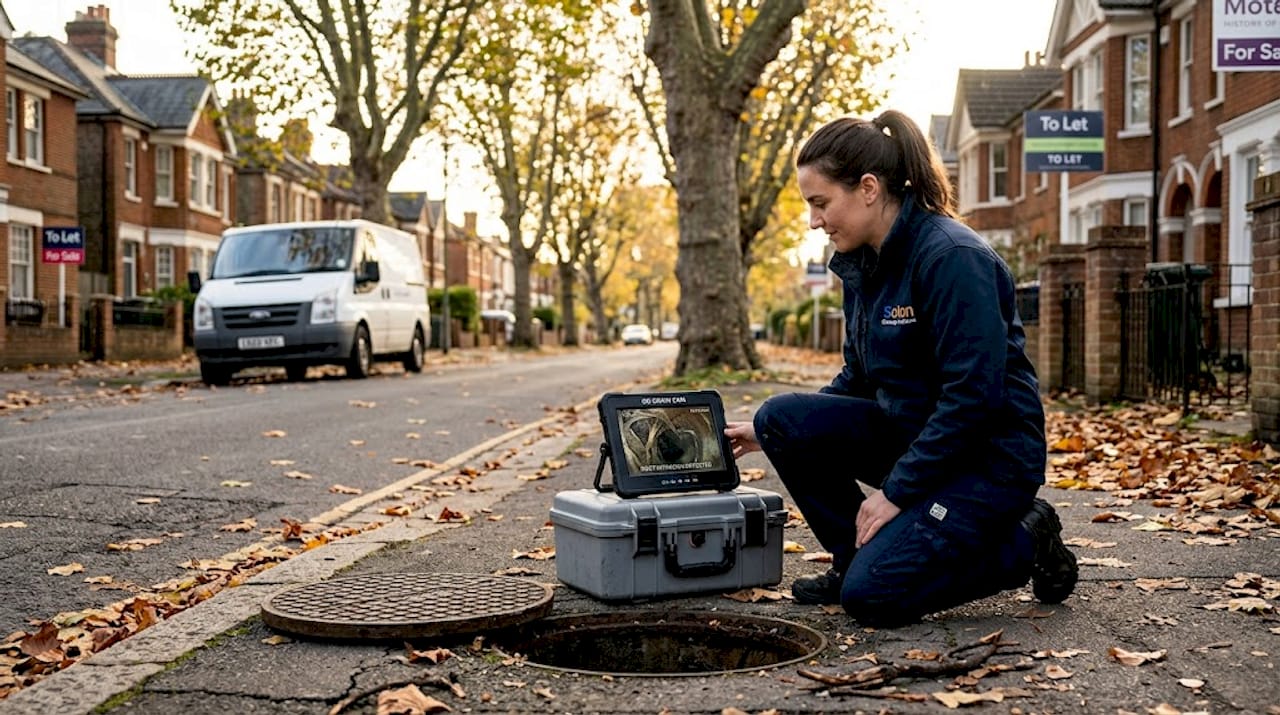
Southampton’s older residential streets carry a particular risk from mature tree root systems. Areas around Bitterne, Shirley, and Bassett are notable for root mass intrusion into clay pipes. Scheduling a root-specific inspection using a rotating cutter head before any structural works begins in these zones can save weeks of remedial delay.
For commercial sites, particularly kitchens, restaurants, and food processing facilities, FOG (fats, oils, and grease) surveys should be integrated into planned maintenance programmes, not just reactive callouts. The preventive surveys benefits for this approach are well established, and contractors managing older historic property challenges will find structured survey schedules significantly reduce emergency callouts.
Pro Tip: Always ask Southern Water whether the pipes on your site fall within their adopted network before starting surveys. Private and adopted drainage have different ownership implications and different compliance requirements.
Produce actionable, structured reports the right way
A survey is only as useful as the report it produces. A PDF with a few blurry screenshots and a vague narrative is not a compliant deliverable — it is a liability waiting to surface when the client queries a defect six months later.
Here is what every compliant, professional drain survey report must contain:
- Executive summary — Plain-language overview of findings, condition grade, and recommended actions, written so a non-technical client can understand it immediately.
- MSCC5-coded defect table — Each defect listed with its code, location, severity grade, and a corresponding HD snapshot (minimum 1080p).
- Inclinometer and gradient data — Showing pipe falls across the surveyed run, flagging any reverse gradients that cause standing water.
- Geotagged image library — Every image tied to its GPS location, so the client or builder can find the exact point in the ground.
- Structured XML or CSV export — Machine-readable data that the client, their structural engineer, or a water company can import and verify independently.
The UKSTT standards confirm that compliant reports require HD snapshots, inclinometer data, geotags, and structured XML as the baseline for interoperability and data integrity.
A striking industry figure worth keeping in mind: 28% of drainage jobs are remedial, meaning contractors are being called back to fix work that was not identified or addressed properly the first time. Thorough, structured reporting directly reduces this number. When the original report is clear, coded correctly, and supported by verifiable data, there is no ambiguity about what was found, what was recommended, and what the client agreed to address.
For an overview of available drainage reporting services or help with reliable drain survey bookings that meet these standards, the resources available locally in Southampton make it straightforward to commission compliant work from the outset.
What most contractors miss about drain survey success
Here is an uncomfortable truth. Most contractors who use drain surveys still under-use them. They commission the minimum required, accept whatever report lands in their inbox, and move on. When problems surface later, they spend far more resolving them than a proper survey and follow-through would ever have cost.
The real differentiator is not the technology or even the standard. It is the human review step. AI-assisted coding is emerging rapidly, but human oversight remains mandatory and NADC-accredited teams are the most trusted precisely because they enforce this step rigorously. Skipping it, or choosing a cheaper team that skips it, is where avoidable remedials originate.
Local knowledge also matters more than most contractors realise. Understanding which Southampton streets carry Victorian clay laterals prone to root infiltration, which areas sit near Southern Water adoption boundaries, and which commercial zones have persistent FOG histories turns a standard CCTV run into a genuinely predictive tool. Pairing that knowledge with proper reporting structures — following drainage infrastructure best practices — is what separates contractors who rarely get called back from those who regularly do.
Partner with experts for reliable drain surveys in Southampton
Putting these tips into practice is significantly easier when you have a locally based, accredited survey team behind you.
Our team at Blocked Drains Southampton provides complete drainage services that cover every stage of your project — from pre-purchase CCTV surveys through to post-construction compliance reports. Every survey uses HD camera systems, inclinometer data, and geotagged outputs, with MSCC5-coded reporting as standard. We understand Southampton’s drainage infrastructure in detail, including its tree-root risks, Victorian pipe networks, and Southern Water boundaries. When you need to schedule a local survey that stands up to client, insurer, and regulatory scrutiny, we are ready to move fast and deliver reports that protect your project from day one.
Frequently asked questions
What is the MSCC5 drain survey standard?
MSCC5 is the UK’s official standard for coding and reporting drain defects, and water companies require these codes before accepting any survey submission.
Why is NADC accreditation important for drain contractors?
NADC-accredited contractors meet strict technical and safety requirements, and their reports are trusted by clients and regulators because OS19X qualification guarantees surveyor competence.
Should AI assist be used for drain survey coding?
AI speeds up defect identification significantly, but human oversight remains mandatory for every AI-generated code before a report is signed off by an accredited surveyor.
What are the minimum deliverables for a compliant drain survey report?
A compliant report must include HD video and snapshots, inclinometer gradient data, geotagged images, and structured XML output to meet interoperability requirements.
When are drain surveys most useful for Southampton projects?
They deliver the most value before purchase, during pre-construction planning, and after completion, as pre and post-construction surveys prevent CDM risks and hidden structural issues from surfacing later.