TL;DR:
- Drain excavation becomes essential when pipes are severely collapsed, roots have caused structural damage, or long-term deterioration makes surface methods ineffective. It involves controlled earth removal to access and repair underground pipe failures, following thorough CCTV diagnosis and careful planning to minimize disruption. Proactive maintenance and early detection help homeowners avoid costly, invasive excavations by addressing issues promptly with less disruptive solutions.
Many Southampton homeowners assume a blocked drain can always be fixed with a quick blast of water jetting or a few passes with a drain rod. That assumption is understandable, but it’s often wrong. When a drain has collapsed, suffered severe root intrusion, or been structurally compromised for years, surface-level solutions simply won’t hold. Excavation becomes not just an option but the only path to a permanent fix. Understanding exactly when and why excavation is necessary can save you from repeated call-outs, escalating costs, and the kind of sewage-related damage that turns a manageable repair into a major property headache.
Table of Contents
- What is drain excavation?
- Common reasons for drain excavation
- The drain excavation process: step-by-step
- Risks, costs, and how to avoid unnecessary excavation
- A fresh perspective on drain excavation: what most guides miss
- Expert drainage excavation and repair in Southampton
- Frequently asked questions
Key Takeaways
| Point | Details |
|---|---|
| Drain excavation defined | Excavation is the physical exposure and repair of underground drains when less invasive solutions fail. |
| Signs indicating excavation | Repeated blockages, collapsed pipes, and chronic flooding often mean excavation is necessary. |
| Avoidance is possible | Routine inspections and cleaning can help prevent the need for disruptive excavation. |
| Professional assessment is vital | CCTV surveys and clear diagnostics ensure excavation is only carried out when truly required. |
| Local expertise matters | Southampton-based specialists know the local soil and infrastructure for effective solutions. |
What is drain excavation?
Drain excavation is the controlled removal of earth, concrete, or other surface material to physically expose and access damaged or blocked underground pipework. It is not a first response. Professionals only recommend it once less invasive approaches have been ruled out or have already failed to deliver a lasting result.
The core distinction between excavation and other drainage methods is depth of intervention. High-pressure water jetting clears blockages from inside the pipe without disturbing the ground. Drain relining inserts a resin-coated liner into an existing pipe to seal cracks and restore flow. Rodding physically dislodges soft blockages using flexible rods pushed through access points. All three methods work within the pipe itself. Excavation, by contrast, goes outside the pipe to address structural failure from the ground up.
The specialist drain excavation work we carry out covers a specific range of serious problems:
- Collapsed or crushed pipework that cannot be relined because the pipe has lost its shape
- Severe root ingress where tree roots have grown through joints or cracks and caused structural damage
- Pipe displacement or misalignment where sections have shifted and created a persistent low point
- Long-term blockages that have caused corrosion, fracturing, or total pipe failure
- Failed or deteriorated older clay pipes commonly found under Southampton’s Victorian-era properties
“Excavation is not a sign of failure in drainage maintenance. It’s often the only way to properly fix what was never installed correctly in the first place, or what has simply reached the end of its service life.”
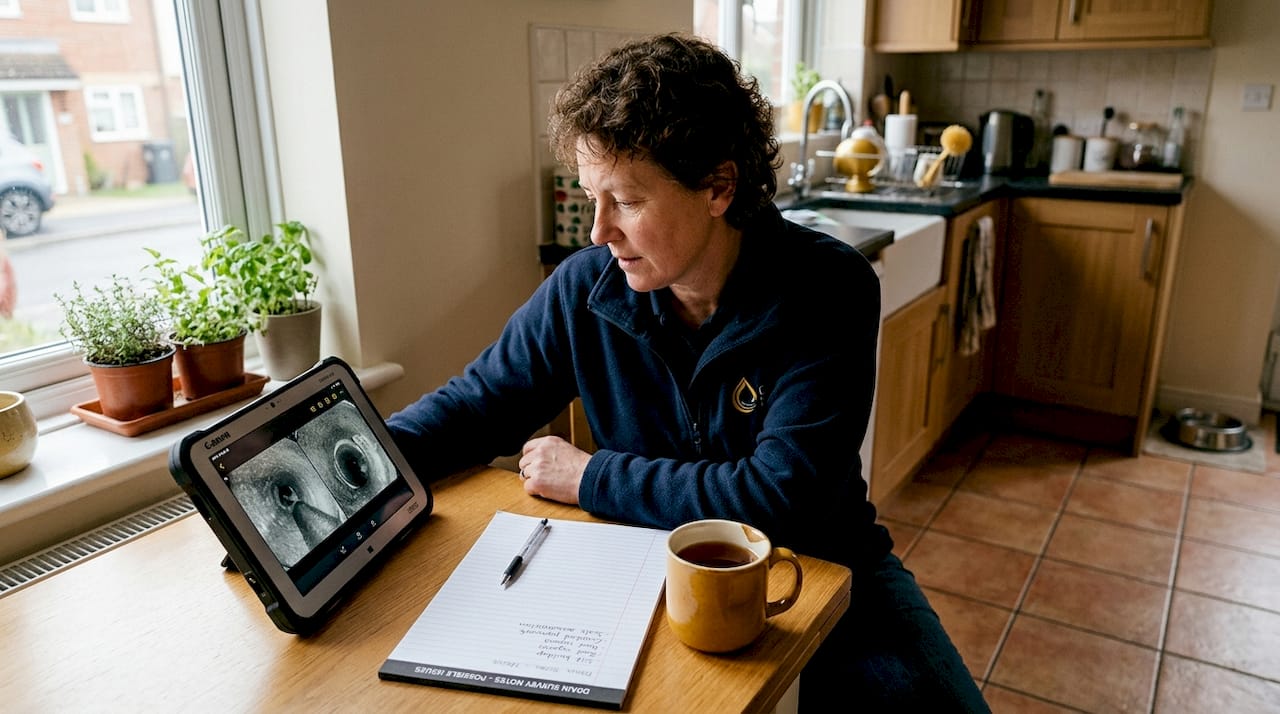
Before excavation begins, CCTV drain surveys are used to pinpoint the exact location and nature of the damage. Without this diagnostic step, a contractor is essentially guessing, which risks unnecessary digging and inflated costs.
| Method | Suitable for | Disruption level | Cost range |
|---|---|---|---|
| High-pressure jetting | Soft blockages, grease, debris | Very low | Low |
| Drain rodding | Minor blockages near access points | Very low | Low |
| Drain relining | Cracked or slightly displaced pipes | Low | Medium |
| Excavation and repair | Collapsed, crushed, or severely damaged pipes | High | High |
Common reasons for drain excavation
Understanding why excavation becomes necessary helps you spot warning signs early and act before the problem escalates. The causes of blocked drains range from everyday household habits to the specific geography and infrastructure of Southampton itself.
Here are the five most common triggers for drain excavation:
-
Persistent blockages from fats, oils, and non-flushable wipes. When these materials build up repeatedly over years, they create a hardened, cement-like mass inside the pipe. Eventually, the pipe walls can crack under pressure or the blockage accelerates corrosion to the point where jetting alone doesn’t resolve it.
-
Tree root intrusion. Southampton has extensive green canopy coverage, and tree roots are naturally drawn to the warmth and moisture inside drainage pipes. Roots enter through joints, cracks, and inspection chambers. Over time, they expand, fracturing the pipe from within and eventually causing full collapse.
-
Cracked, broken, or misaligned pipes. Ground movement, frost, vehicle loading on driveways, and the age of original pipework all contribute to cracking and joint separation. Misaligned pipes create low points where debris accumulates and raw sewage can pool.
-
Repeated flooding and sewage backing up. If you’re experiencing recurring drain flooding, slow drainage from multiple fixtures, or sewage odours in your garden, these are strong signals that the problem is structural, not just a surface blockage.
-
Corroded or end-of-life clay and iron pipes. Many Southampton properties, particularly in older suburbs like Shirley, Freemantle, and St Denys, still have original Victorian clay drainage that has reached or exceeded its expected lifespan.
| Symptom | Likely cause | Recommended action |
|---|---|---|
| Single slow drain | Localised blockage | Jetting or rodding |
| Multiple slow drains | Shared drain blockage | CCTV survey, then jetting |
| Recurring blockages | Structural issue or root ingress | CCTV survey, possible relining |
| Sewage smell in garden | Cracked or displaced pipe | CCTV survey, excavation likely |
| Sunken soil or wet patches | Collapsed drain leaking | Urgent CCTV and excavation |
The drain excavation process: step-by-step
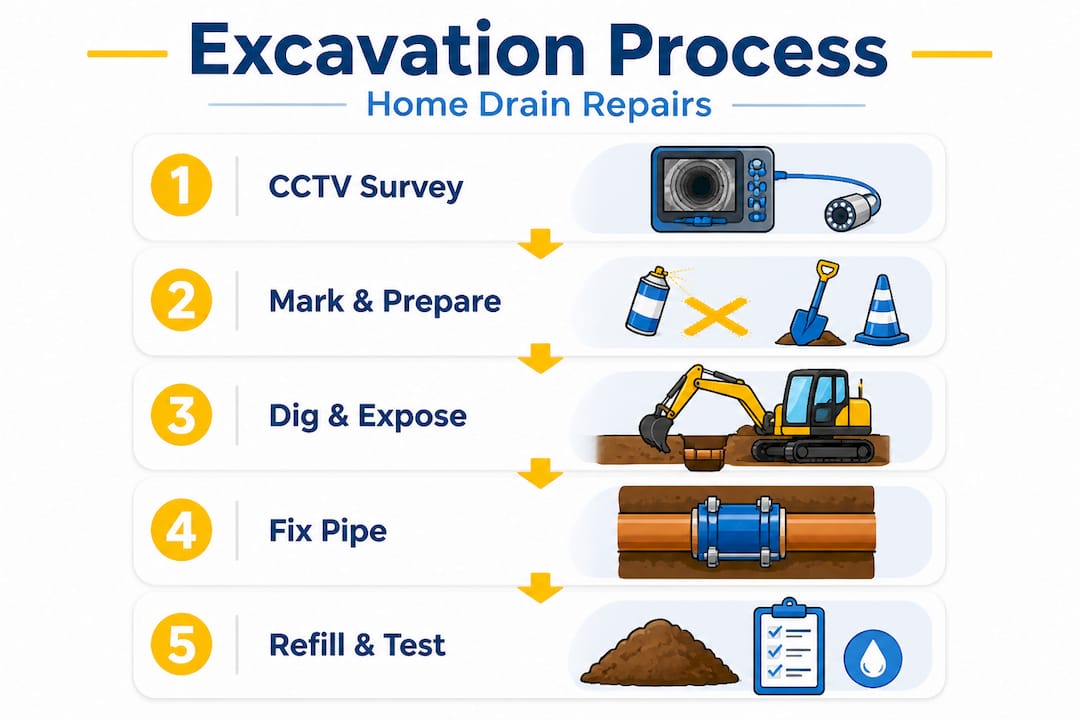
So, if a drain on your property requires excavation, here’s what the process looks like in detail. Knowing each stage reduces anxiety, helps you prepare your property, and lets you hold your contractor to account throughout.
-
Initial survey and diagnosis. The process always begins with a CCTV camera inspection. A flexible camera is fed through the drain to identify the exact location, depth, and nature of the damage. This produces a recorded report and pinpoints where excavation must occur, avoiding unnecessary digging elsewhere on your property.
-
Marking dig points and access planning. Once the survey data is confirmed, the affected area is marked. If the drain runs beneath a public pavement or road, your contractor will need to apply for a Section 50 licence from Southampton City Council before work begins. For private land, access is arranged with you directly.
-
Careful excavation of the affected pipe. Using mini-excavators, hand digging, or a combination of both, the ground is removed in controlled stages to expose the damaged pipe section. Care is taken to avoid disrupting other utilities such as gas, electric, and water mains that run nearby.
-
Pipe repair or full replacement. Once exposed, the damaged section is assessed. If a short section is broken, it can be cut out and replaced with a matching new pipe. If the damage is more extensive, a longer replacement run may be required. Joints are carefully sealed to prevent future root ingress or ground movement.
-
Reinstatement of the excavated area. After repair, the trench is backfilled in layers and compacted to the required standard. Surface materials, whether topsoil, concrete, tarmac, or paving, are reinstated to match the surrounding area as closely as possible. Any landscaping disrupted during the dig is restored.
Pro Tip: Always ask for a post-repair CCTV survey before your contractor leaves site. This confirms the repair is seated correctly, joints are sealed, and flow is restored before the area is backfilled and reinstated.
If you face an urgent situation, emergency drain clearing can provide immediate containment while a longer-term repair is planned. For ongoing care, investing in professional drain cleaning helps prevent the kind of build-up that accelerates structural damage in the first place.
Risks, costs, and how to avoid unnecessary excavation
Understanding that excavation is resource-intensive, it’s crucial to know the associated risks, costs, and how to reduce the need for it on your property. Being informed puts you in control rather than simply reacting to a crisis.
What excavation can disrupt:
- Garden landscaping, lawns, patios, and driveways
- External access routes around your property
- Neighbouring properties if the shared drain runs through their land
- Normal daily routines for two to five working days on average
- Utility services running parallel to or crossing the affected drain
Residential drain excavation costs in the UK typically range from £800 to £3,500 or more, depending on depth, pipe diameter, access constraints, and surface reinstatement requirements. Complex jobs involving shared sewers, deep excavations, or extensive surface repairs can push costs considerably higher. These figures are why catching problems early matters so much for homeowners and property managers.
Services that prevent costly repairs are almost always far cheaper than the excavation they help you avoid. A routine CCTV drain survey, for instance, typically costs a fraction of the price of emergency excavation.
Pro Tip: If you are purchasing a property in Southampton, request a pre-purchase drain survey. Many serious drainage defects are invisible at surface level and won’t appear on a standard structural survey. A pre-purchase survey can save you from inheriting very expensive problems.
Most excavations are entirely avoidable with a consistent maintenance approach. Here’s what proactive property management looks like in practice:
- Schedule a CCTV drain survey every three to five years, especially in older properties
- Avoid flushing wipes, fats, and non-biodegradable materials down any drain
- Monitor large trees close to your property and consider root barriers if they are near drainage runs
- Respond promptly to slow drains rather than waiting months for the problem to worsen
- Keep inspection chamber covers accessible and check them periodically after heavy rain
Early action is the single biggest factor in avoiding excavation. A hairline crack identified during a routine survey can often be relined in a day. The same crack, left undetected for five more years, may result in full pipe collapse requiring a multi-day dig.
A fresh perspective on drain excavation: what most guides miss
Most guides on drain excavation focus on process and cost, which is useful, but they rarely address the mindset gap that causes the most problems for Southampton homeowners. Here’s the uncomfortable truth: the word “excavation” causes people to either panic immediately or delay action entirely. Both responses lead to worse outcomes.
When we attend a property and recommend excavation, the most common reaction is disbelief, quickly followed by asking whether we’re sure it’s necessary. That scepticism is actually healthy. You should ask. Any reputable contractor should be able to show you the CCTV footage, explain exactly what it shows, and describe precisely why less invasive methods won’t work in this particular case. If a contractor recommends excavation without offering camera evidence, ask for it before agreeing to any work.
The flip side is equally damaging. Some property owners know there’s a drain problem but put off getting it properly investigated. A slow drain becomes recurring flooding. Recurring flooding becomes sewage leaking into soil. By the time excavation is finally agreed, the scope of work has tripled. This pattern is frustrating because it’s entirely preventable.
Advances in diagnostics have genuinely changed this field. Modern push-rod cameras and sonar profiling equipment can assess pipe condition with a level of accuracy that simply wasn’t possible fifteen years ago. In a growing number of cases, what looks like an excavation job from the surface turns out to be resolvable with precision relining once the full picture is clear. The diagnostic investment pays for itself.
What we always encourage Southampton property managers and homeowners to do is treat drain maintenance the same way they treat boiler servicing: as a scheduled, annual or biennial task, not a crisis response. The drain network under your property is just as critical as any other building system. Reviewing the options with book reliable drain services before problems escalate is always the smarter path.
The specialist drain excavation services we provide are backed by full diagnostic evidence every time, so you always understand exactly why a job has been recommended and what outcome to expect.
Expert drainage excavation and repair in Southampton
If you suspect excavation may be necessary or want to stay ahead of drain issues, reliable local support is available right across Southampton and the surrounding areas.
Our team provides drain excavation and repair services covering everything from initial CCTV diagnosis through to full pipe replacement and surface reinstatement. We bring local knowledge of Southampton’s drainage network, soil conditions, and infrastructure challenges to every job. Protecting your property also means investing in regular drain survey protection so that problems are caught before they become costly. For properties with garden drainage concerns, our soak away clearance advice helps you manage groundwater effectively and reduce the risk of saturation affecting your drain runs. Get in touch today to discuss your situation with a specialist who understands Southampton drainage from the ground up.
Frequently asked questions
How long does drain excavation usually take?
Most standard residential drain excavations are completed in one to three days, depending on complexity and site conditions. Larger or deeper jobs, or those involving surface reinstatement, may take longer.
Is drain excavation covered by home insurance?
Cover varies, but many policies pay for repairs caused by insured risks like drain collapse. Always check your policy details and speak with your insurer before work begins to understand what documentation you’ll need.
Can drain problems be fixed without excavation?
Yes, many issues can be resolved with methods like high-pressure water jetting or relining, but severe damage may require excavation. The right method depends on what a CCTV survey reveals about the pipe’s condition.
What should I look for in a drain excavation contractor?
Choose firms with proven local experience, specialist equipment, and transparent diagnostics backed by CCTV evidence. Always ask to see the survey footage before agreeing to any excavation work.
Are there alternatives to replacing damaged pipes by excavation?
In some cases, relining or patch repairs inside the pipe can avoid excavation entirely. However, not all situations allow for this, particularly where pipes have collapsed or become severely displaced.