TL;DR:
- Common drain blockages in Southampton include grease, hair, wipes, roots, and sediment buildup.
- Proper tools, safety precautions, and early diagnosis ensure effective DIY drain clearance.
- Professional surveys and guarantees are recommended to address underlying issues and prevent recurrences.
A blocked drain has a talent for ruining your day at the worst possible moment. One minute you’re running the kitchen tap; the next, murky water is backing up into the sink while an unpleasant smell drifts through the house. For Southampton homeowners, the problem is compounded by the city’s ageing pipe network, coastal groundwater, and dense tree cover in residential streets. This guide gives you a clear, practical path from spotting the first warning signs to confirming the blockage is completely gone, with local recommendations so you know exactly who to call if the situation moves beyond a simple DIY fix.
Table of Contents
- Understanding the problem: Common causes of drain blockages
- Preparation: What you need before starting drain clearance
- Step-by-step: How to clear a blocked drain
- Ensuring success: How to verify the drain is clear and prevent future issues
- Why quick fixes aren’t enough: What most homeowners miss about drain clearance
- Get local help: Southampton’s trusted drain clearance solutions
- Frequently asked questions
Key Takeaways
| Point | Details |
|---|---|
| Identify common causes | Knowing what commonly blocks local drains helps you spot problems early and act swiftly. |
| Prepare the right tools | Having gloves, a plunger, and local contacts means you can respond safely to most blockages. |
| DIY or call a pro | Choose self-clearance for small blockages but use local experts for severe or repeated problems. |
| Verify and maintain | Check clearance success and practise good habits to reduce future risk. |
| Trust local reputation | Southampton homeowners should choose services with strong reviews, proper guarantees, and transparent communication. |
Understanding the problem: Common causes of drain blockages
Before you reach for the plunger, it pays to understand what you are actually dealing with. Knowing the cause of a blockage helps you choose the right approach and avoid making things worse.
According to blocked-drainssouthampton.co.uk, grease, hair, wipes, roots are the leading culprits behind residential blockages. Each of these behaves differently inside a pipe, and each needs a slightly different response.
The most common causes of blocked drains in Southampton homes:
- Cooking grease and fat solidify as they cool, coating pipe walls and gradually narrowing the flow until almost nothing passes through.
- Wet wipes and sanitary products are labelled “flushable” by manufacturers, yet they do not break down like toilet paper. They snag on pipe joints and collect other debris around them.
- Hair forms dense clumps in bathroom drains, trapping soap residue and eventually forming a plug.
- Food waste especially coffee grounds, rice, and pasta swell inside pipes and bind together into a stubborn mass.
- Tree root intrusion is a particularly serious issue in older Southampton streets where mature trees grow close to Victorian-era clay pipe runs. Roots are drawn toward the warmth and moisture inside sewer pipes and, over time, how roots block drains becomes a serious structural problem rather than a simple blockage.
- Mineral scale and sediment build up slowly in areas with hard water, restricting flow without any obvious single trigger.
Recognising a blockage early saves you money and stress. The warning signs are usually subtle at first. Water drains more slowly than normal. A gurgling noise rises from the plughole after the basin empties. A faint but persistent odour comes from the drain, particularly noticeable in warm weather. These signals mean the pipe is partially obstructed, and if you act at this stage, a straightforward remedy is usually all that is needed.
If you ignore slow drainage and wait until water pools on the floor or backs up into the bath, you are looking at a much harder clearance job and a real risk of water damage to floors and walls.
Left long enough, partial blockages become complete ones, and the trapped organic matter inside the pipe continues to decompose, worsening the smell and increasing the likelihood of bacterial contamination. Southampton’s older housing stock, particularly terraced properties in areas such as Shirley, Portswood, and St Denys, is especially prone to root intrusion because of the proximity of large street trees to original clay drainage runs. Knowing this means you can also read up on tree root prevention tips before problems develop, rather than after.
Preparation: What you need before starting drain clearance
Good preparation turns a stressful situation into a manageable task. Gather the right equipment before you start, and you avoid making additional trips to the hardware shop mid-job or, worse, spreading contaminated water around the bathroom floor.
Essential drain clearance toolkit
| Tool | Purpose | Notes |
|---|---|---|
| Rubber plunger (cup style) | Creates suction to dislodge soft blockages | Ensure a tight seal around the drain opening |
| Drain rods with attachments | Breaks up and removes deeper blockages | Use a worm screw or plunger head attachment |
| Drain snake (hand auger) | Reaches blockages beyond the plunger’s range | Ideal for bathroom pipes and U-bends |
| Rubber gloves (heavy duty) | Protects hands from contaminated water | Use long-cuff gauntlets for rodding work |
| Safety goggles | Prevents splashback to eyes | Essential when using rods or applying any product |
| Mop and bucket | Manages water overflow during clearance | Have these within easy reach before starting |
| Torch | Illuminates inspection chamber or gully trap | A head torch is best for hands-free use |
| Phone (charged) | Contact local professionals if needed | Keep the number for a reliable drain service saved in advance |
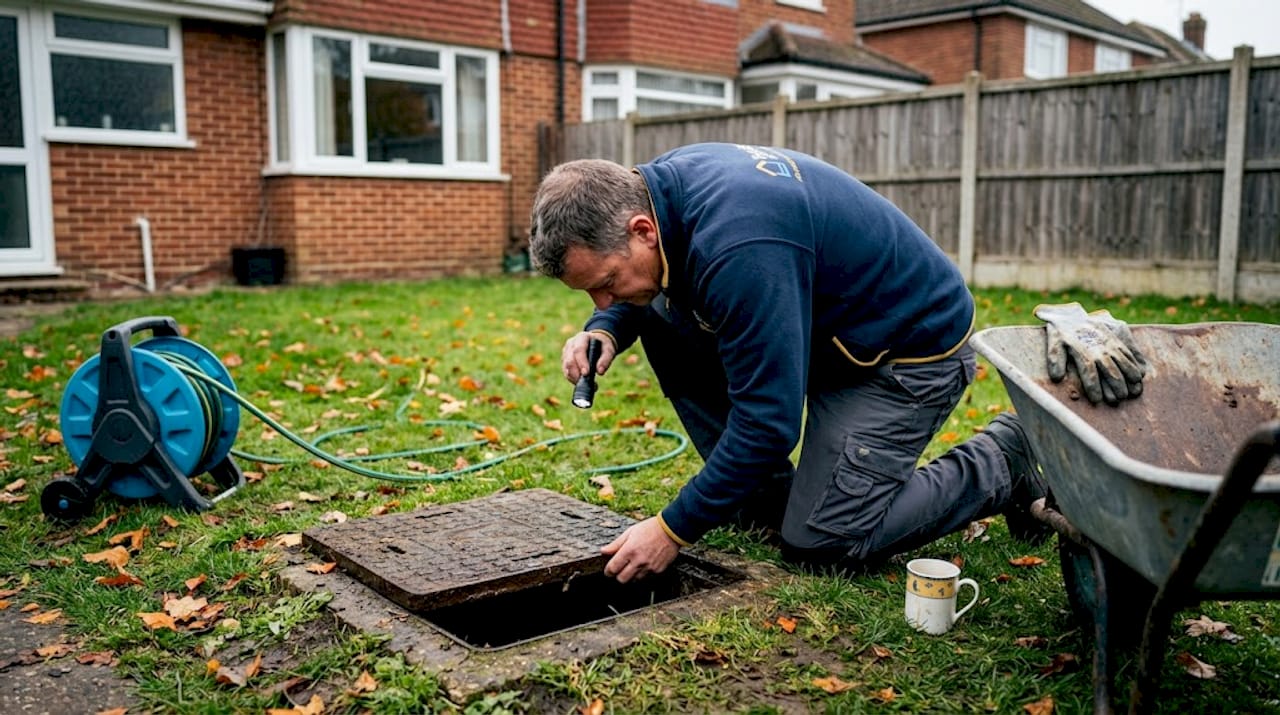
Before you touch the drain, gather some basic information. Locate your property’s main inspection chamber, which is usually a square or rectangular cover in the garden or driveway. Check whether there is any visible overflow or signs that the blockage is affecting more than one fixture. If the kitchen sink, bathroom basin, and downstairs toilet are all slow at the same time, the blockage is likely in the shared main drain run rather than an individual branch pipe, and that changes your approach significantly.
Note any recent changes at the property: new trees planted near drainage runs, work carried out on the road outside, or repairs by a utility company. These can all affect your drainage system in ways that are not immediately obvious.
As professional kits and safety precautions confirm, correct equipment and careful preparation reduce the risk of turning a partial blockage into a more serious pipe failure.
Pro Tip: Always lay down old towels or newspaper before opening a drain cover indoors. Contaminated water can carry bacteria, and you do not want it spreading across tiles or floorboards. Keep your work area as contained as possible.
Step-by-step: How to clear a blocked drain
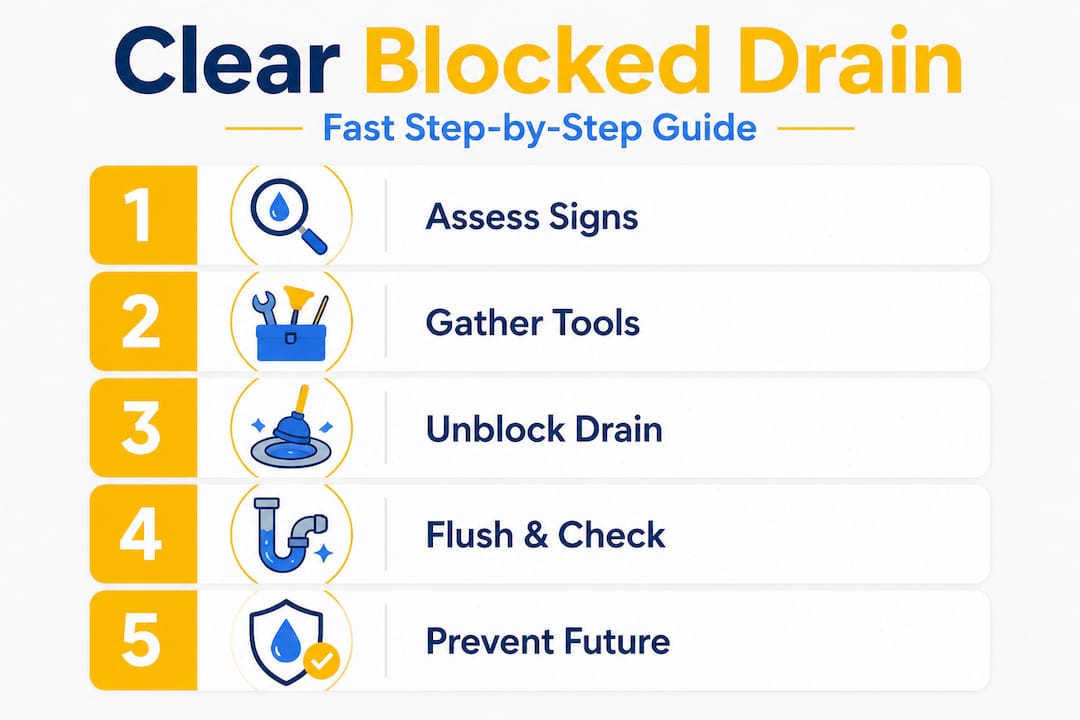
With your tools assembled and the blockage located, you can now work through a logical sequence of steps. Start with the gentlest method and escalate only if needed.
- Check the inspection chamber first. Lift the cover using a flat-head screwdriver. If the chamber is full of water, the blockage is downstream. If it is empty, the blockage is between the chamber and your property.
- Try a plunger on the affected fixture. Place the rubber cup firmly over the drain opening, ensuring a complete seal. Push down and pull back sharply ten to fifteen times. This often dislodges soft grease or hair clogs.
- Use a drain snake for bathroom drains. Insert the flexible auger into the plughole and rotate the handle clockwise as you push forward. When you feel resistance, work the snake back and forth to break up or hook the blockage.
- Deploy drain rods for the main drain run. Attach a plunger head or worm screw to the first rod, insert it into the inspection chamber, and add further rod sections as you push forward. Rotate clockwise only; turning anticlockwise risks unscrewing and losing rods inside the pipe.
- Flush with hot water. Once you believe the blockage is clear, flush with several litres of hot (not boiling) water and check that it runs away freely without backing up.
- Clear any outdoor gully traps. Leaves, moss, and silt collect in surface gullies. Remove the grid, scoop out the debris by hand, and flush with a garden hose.
Pro Tip: Never pour neat bleach or caustic soda into a blockage in the hope of dissolving it quickly. Harsh chemicals can corrode older clay and cast-iron pipes common in Southampton’s Victorian housing stock, potentially causing leaks that are far more expensive to repair than the original blockage.
When to DIY and when to call a professional
| Situation | DIY appropriate | Call a professional |
|---|---|---|
| Single slow-draining sink or bath | Yes | No |
| Multiple fixtures blocked at once | No | Yes |
| Outdoor drain overflowing | Possibly | Recommended |
| Foul smell with no visible cause | No | Yes |
| Repeat blockage within weeks | No | Yes |
| Any sign of structural damage | No | Yes |
| Root intrusion suspected | No | Yes |
When choosing a local specialist, best-rated drain services in Southampton are worth researching before you commit. Look at verified customer reviews on independent platforms rather than relying solely on a company’s own website. For context, Pure Drainage’s 5.0 average from 87 reviews on Birdeye illustrates how consistent service quality shows up in customer feedback over time. Use these ratings as a first filter, then confirm the company offers a written guarantee on their work, covers your postcode, and will provide a fixed price before starting.
Ensuring success: How to verify the drain is clear and prevent future issues
Clearing the blockage is only half the job. Confirming the drain is truly clear, and building habits that keep it that way, is what separates a one-off fix from a lasting solution.
How to confirm the clearance has worked:
- Run the cold tap at full flow for at least two minutes and watch the drain closely. Water should disappear instantly with no pooling or swirling.
- Flush the toilet twice in succession. A healthy drain handles this without hesitation.
- Check for any lingering odours. A properly cleared drain should produce no smell from the basin or toilet, even in warm weather.
- Inspect the inspection chamber again. The base should be clear of standing water.
- Ask someone to run water from an upstairs fixture while you watch the chamber. This confirms the main drain run is moving freely.
Once you are satisfied the drain is clear, the ongoing maintenance and periodic inspection that prevents repeat blockages is not complicated, but it does require consistency.
Simple habits that protect your drains:
- Pour cooled cooking fat into a sealed container and bin it rather than tipping it down the sink.
- Fit stainless steel mesh screens over every plughole to catch hair and food particles.
- Check outdoor gully grids monthly, particularly in autumn when leaf fall is heavy.
- Avoid putting coffee grounds, rice, pasta, or citrus peels down the kitchen sink.
- Run the outside tap to flush garden drains at least once a month.
- Arrange a professional drain survey if your property is more than thirty years old or if you experience a blockage more than once a year.
Pro Tip: After any blockage clearance, take a quick photo of your inspection chamber at its normal, clear state. If a dispute arises with a contractor later, or you need to make an insurance claim, that “before” reference image is genuinely useful. Keep it in a folder on your phone alongside any receipts or guarantee documents from the work.
For longer-term reassurance, a CCTV drain survey gives you a definitive picture of what is happening inside your pipes. It is particularly worthwhile if you are buying an older Southampton property or if you have had root intrusion before. For a detailed overview of what to expect, the drainage infrastructure tips page provides excellent guidance specific to Southampton homes.
Why quick fixes aren’t enough: What most homeowners miss about drain clearance
Here is a perspective that most guides skip over entirely. Clearing a blockage and fixing a drain are two different things, and too many Southampton homeowners only ever do the first.
A plunger or a set of rods will restore flow in a partially blocked pipe. But if the underlying cause is a cracked pipe, a displaced joint, a root that has grown back after a previous clearance, or a gradual collapse in an ageing clay run, the blockage will return within weeks. You will be back to the same problem, possibly worse, and you will have spent money on repeat call-outs that could have paid for a proper survey and repair.
The other thing homeowners routinely miss is the guarantee question. When you hire a drain clearance company, ask specifically: what does your guarantee cover, and for how long? Some companies offer a guarantee on clearing the blockage but not on the underlying pipe condition. That is almost meaningless if you have a structural fault. Southampton homeowners benefit most when they verify those guarantees thoroughly before work begins, not after.
We have seen jobs where a homeowner paid three separate companies over eighteen months to clear the same stretch of pipe, each time getting a “job done” sign-off and no further follow-up. A single CCTV survey at the start would have identified a root intrusion and a cracked junction, which could have been relined in one visit for less than the combined cost of those three clearances. For genuinely reliable guidance on this, the expert drain survey advice page is worth reading before you make any decisions about who to hire.
Good local drainage companies do not just unblock. They advise. They survey. They give you transparent quotes and explain what they found. If a company turns up, rods the drain, takes payment, and leaves without any explanation of what caused the blockage or what to watch for, that should raise a question in your mind.
Get local help: Southampton’s trusted drain clearance solutions
If you have worked through this guide and still face a stubborn blockage, or you simply want the job done properly from the start, Southampton has reputable local professionals ready to help.
Our drain clearance services cover everything from emergency unblocking to full CCTV surveys and pipe relining, all delivered by specialists who know Southampton’s drainage infrastructure inside out. Whether you are dealing with a grease blockage in a terraced kitchen, root intrusion in a garden drain, or a recurring problem you cannot get to the bottom of, there is a practical and affordable solution available locally.
For homeowners wanting to understand the full picture, our property drainage solutions page walks through real-world examples from Southampton properties, helping you match your situation to the right service. Book online, request a call, or get in touch today for fast, local support.
Frequently asked questions
How do I know if my drain is actually blocked?
Typical signs include slow drainage, water pooling around plughole, gurgling sounds from pipes, and persistent foul odours, even when the area looks clean.
Should I try to clear a drain myself or call a professional?
For a single, slow-draining fixture you can try DIY first, but call a professional if the blockage is persistent, affects multiple fixtures, or keeps recurring within weeks.
Are chemical drain cleaners safe to use?
Harsh chemicals can corrode older clay and cast-iron pipes common in Southampton, so it is better to use mechanical methods or ask a professional rather than reach for the caustic soda.
What regular maintenance prevents blockages?
Best prevention habits include binning grease rather than pouring it down the sink, fitting plughole screens, and booking an annual professional drain check for older properties.
How do I choose a trustworthy local drain clearance expert?
Look for high verified ratings on independent review platforms, ask about written work guarantees, and confirm they use online ratings alongside a physical Southampton presence to back up their reputation.