TL;DR:
- Non-invasive drain repair uses trenchless methods to minimize surface disruption and preserve property landscaping.
- Techniques like pipe lining, pipe bursting, and patch repair are suitable for various pipe conditions and damage types.
- Proper assessment including CCTV surveys is essential to determine if non-invasive repair is appropriate for Southampton properties.
Non-invasive drain repair: restore your Southampton property
Most Southampton homeowners assume that fixing a damaged drain means watching a team dig up their garden, driveway, or patio for days on end. That assumption costs people time, money, and unnecessary stress. The reality is that modern drain repair has changed significantly, and non-invasive techniques now offer a genuine alternative to traditional excavation for many common drainage problems. This guide explains exactly how these methods work, when they are the right choice, and what you need to know before calling in a contractor.
Table of Contents
- Understanding non-invasive drain repair: What does it mean?
- Types of non-invasive drain repair techniques
- When are non-invasive methods suitable and what limits their use?
- Benefits and challenges for Southampton homeowners
- A professional perspective: What most property owners miss about drain repair
- Take the next step with reliable Southampton drainage experts
- Frequently asked questions
Key Takeaways
| Point | Details |
|---|---|
| Minimise disruption | Non-invasive drain repairs avoid digging up gardens, driveways, or floors. |
| Inspection matters | Surveying the pipes first is essential to choosing the right repair method. |
| Limits to technology | Some pipe problems still require traditional excavation even in 2026. |
| Professional solutions | Local Southampton experts offer both trenchless and traditional services. |
Understanding non-invasive drain repair: What does it mean?
Building on the introduction, let’s clarify what non-invasive drain repair actually involves and why it’s gaining popularity among property owners across Southampton.
Non-invasive drain repair usually refers to trenchless or no/low-dig methods that rehabilitate or replace underground drains with minimal surface excavation. Rather than cutting a long trench from one end of your garden to another, specialists access the pipe through existing openings such as manholes or cleanout points, then work from the inside. The results can be just as effective as a full dig-out, but with a fraction of the mess and disruption.
It’s worth understanding a few terms you’ll encounter when speaking to drainage professionals.
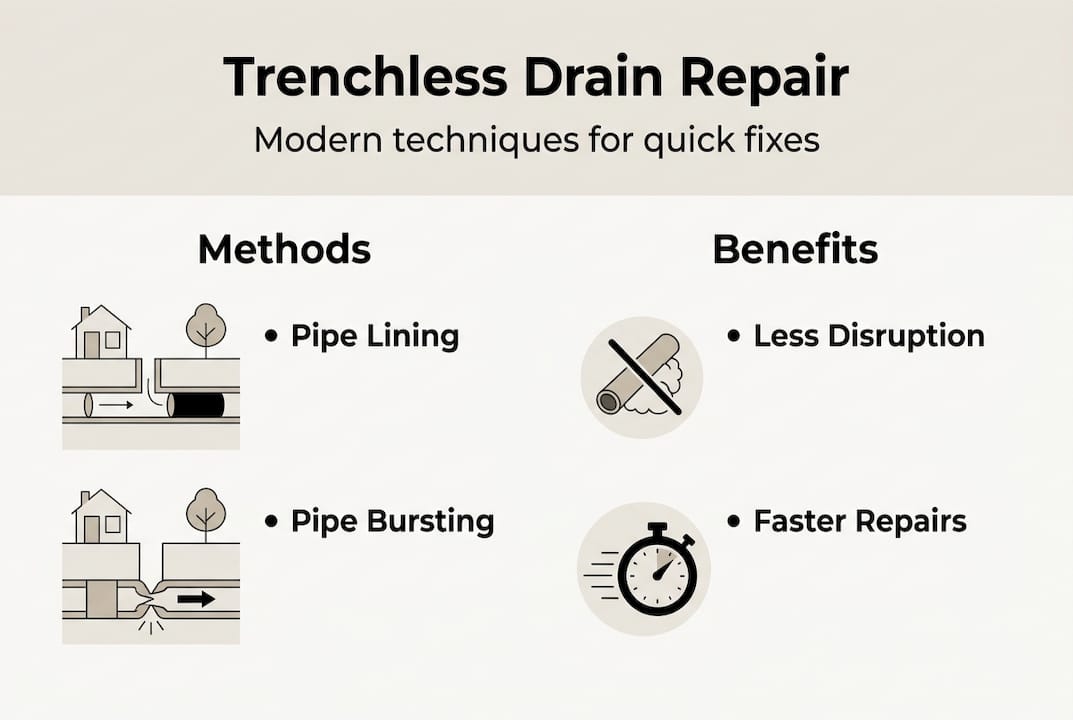
Trenchless technology is the umbrella term for repair methods that avoid continuous trenching. It covers several techniques, the most widely used being pipe lining and pipe bursting. Both share the principle of working through limited access points rather than exposing the entire pipe run.
Pipe lining, sometimes called cured-in-place pipe lining or CIPP, involves inserting a flexible, resin-coated liner into the damaged pipe. The liner is then inflated and the resin is cured, creating a new, smooth pipe wall inside the old one.
Pipe bursting is a replacement method. A bursting head is pulled through the old pipe, fracturing it outwards while simultaneously pulling a new pipe into position behind it.
Here is a quick summary of what sets non-invasive repair apart from traditional methods:
- Access is gained through existing openings, not newly dug trenches
- The surrounding ground, paving, and landscaping remain largely intact
- Repair times are typically shorter because there’s no excavation phase
- Reinstatement costs are lower because there’s less surface damage to make good
- Work can often proceed in tight or difficult-to-access areas
Key statistic: Trenchless drain repairs can reduce project timescales by up to 50% compared with traditional excavation, making them particularly valuable for occupied properties in Southampton where minimal disruption is a priority.
For Southampton specifically, these advantages matter enormously. The city has a mix of Victorian-era properties, post-war housing estates, and modern developments. Older homes often have clay or pitch-fibre pipes beneath beautifully maintained gardens or expensive block-paving driveways. For those homeowners, the prospect of digging everything up is genuinely alarming. Non-invasive methods offer a way to preserve what’s above ground while fixing what’s below.
Types of non-invasive drain repair techniques
Now that we understand the basics, let’s explore the main methods used for non-invasive drain repair and how each one performs in real Southampton property scenarios.
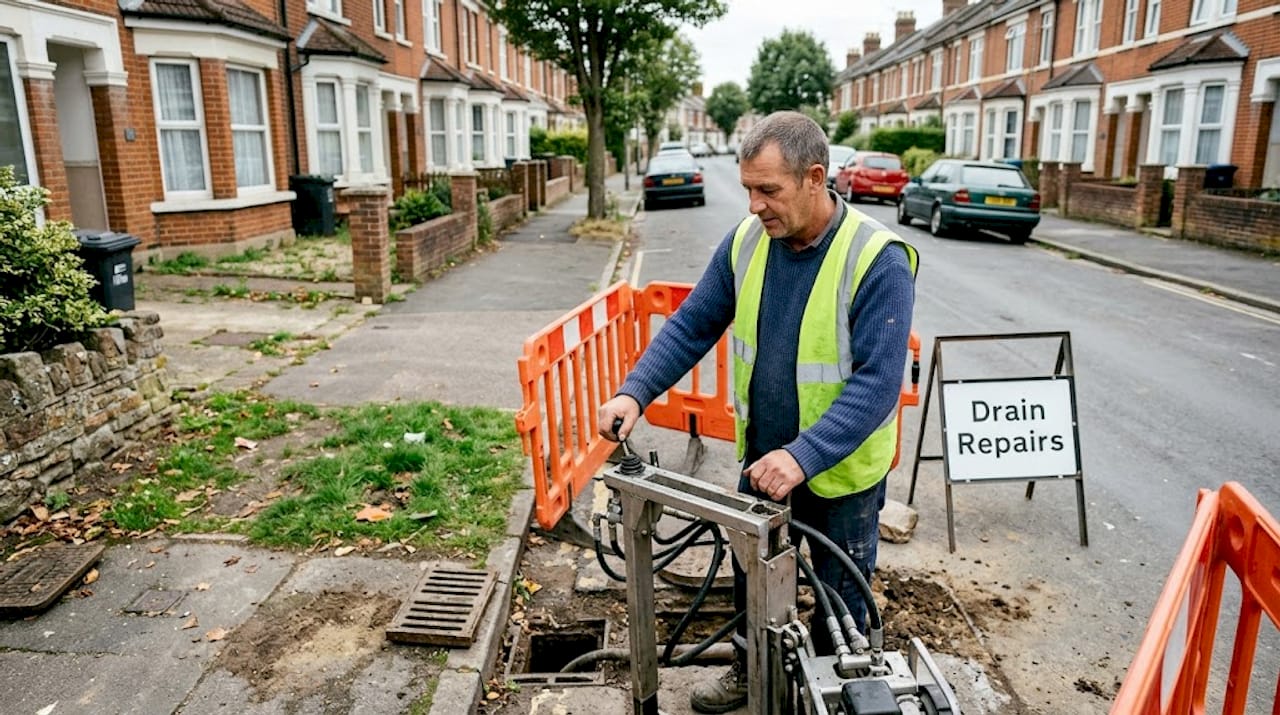
Rather than digging a continuous trench along the pipe run, trenchless drainage services are typically carried out through small access points such as cleanouts or manholes, repairing or renewing the pipe internally or via limited pits. Here’s how the key techniques break down.
Cured-in-place pipe lining (CIPP)
This is the most frequently used non-invasive method. A felt or fibreglass liner, pre-coated with liquid resin, is inserted into the damaged pipe using either a water inversion technique or a pull-in-place system. Once correctly positioned, the liner is inflated with air or water pressure so it presses firmly against the pipe walls. Heat, ultraviolet light, or ambient curing is then used to harden the resin. The result is a structurally sound, seamless pipe within the original host pipe. CIPP works well for cracks, root intrusion, minor joint displacement, and corrosion.
Pipe bursting
Where a pipe is too degraded to line effectively, pipe bursting provides a replacement option without digging up the full run. A bursting head fractured the old pipe outward into the surrounding soil while drawing a new, flexible polyethylene pipe behind it. This method works best where the ground around the pipe can accommodate the slight outward displacement of the old pipe material.
No-dig patch repair
For localised damage such as a single cracked joint or a small section of pipe with root intrusion, patch repair offers a targeted solution. A resin-impregnated patch is inserted and positioned precisely over the defect, then inflated and cured. This avoids treating the entire pipe when only a short section requires attention, making it a cost-effective first step.
Comparison of main non-invasive techniques:
| Technique | Best for | Surface disruption | Typical duration |
|---|---|---|---|
| CIPP lining | Cracks, root ingress, joint failure | Very low | Half a day to 1 day |
| Pipe bursting | Severely degraded pipes needing replacement | Low to moderate | 1 to 2 days |
| Patch repair | Localised defects | Minimal | 2 to 4 hours |
Pro Tip: Always ask your contractor to confirm which lining or bursting system they’re using and request a post-repair CCTV inspection. A reputable drainage company will include this as standard to confirm the repair is sound before leaving your property.
Advantages shared across all three methods include:
- No large trenches cut across gardens, driveways, or public pavements
- Faster reinstatement since only minimal surface areas need to be made good
- Longer-lasting results because modern resin liners are rated for 50 years or more in many cases
- Less noise and machinery on site, which matters greatly in residential areas and for commercial properties with customers on site
There are some limitations to be aware of too. Lining reduces the internal bore of the pipe slightly, which can be a concern for pipes already running at full capacity. Pipe bursting requires suitable soil conditions and enough working space at each end. These factors are why professional assessment always comes before any repair.
When are non-invasive methods suitable and what limits their use?
While trenchless approaches are genuinely promising, it’s vital to assess whether your drainage problem actually qualifies for non-invasive solutions before committing.
Non-invasive drain repair is not a universal solution: pipe condition, access, and structural suitability all determine whether lining or bursting can safely and effectively be used. Understanding these factors upfront saves time and avoids the disappointment of discovering mid-project that a different approach is needed.
Here is a numbered list of the key suitability factors specialists consider:
- Pipe condition: Pipes with cracks, root intrusion, or degraded joints are often ideal candidates for lining. Pipes that have fully collapsed or become badly misaligned cannot hold a liner in place and will require excavation.
- Pipe diameter: Most lining systems work across a range of pipe sizes, typically 100mm to 600mm in diameter. Very small-bore pipework or unusually large sewer mains may fall outside the range of standard equipment.
- Pipe material: Clay, concrete, pitch-fibre, and PVC pipes can all be lined. However, the original pipe needs to offer sufficient structural support to accept the liner without further failure during insertion.
- Access points: Trenchless methods depend on access via manholes or cleanouts. Where these are absent or blocked, some minor excavation to create an access pit may be needed before the trenchless work can begin.
- Pipe configuration: Sharp bends, multiple junctions, or complex pipe layouts can make it difficult to navigate the liner or bursting head through the system. Simpler, straighter runs are always easier to treat without additional work.
Professionals typically start with a thorough drain survey using a CCTV camera to determine whether the pipe can be lined rather than needing full replacement. If the pipe is too deteriorated, collapsed, or misaligned, trenchless options may be constrained and excavation or traditional replacement may be required.
Suitability assessment summary:
| Pipe condition | Recommended approach |
|---|---|
| Cracks, joint gaps, root ingress | CIPP lining or patch repair |
| Severely degraded but intact | Pipe bursting |
| Fully collapsed or misaligned | Traditional excavation |
| Multiple junctions, complex layout | Professional assessment required |
Pro Tip: Request a CCTV drain survey before agreeing to any repair quote. This produces a video record of the pipe’s exact condition and gives you concrete evidence to compare quotes from different contractors. It also protects you if disputes arise about the scope of work later.
“A CCTV inspection is not an optional extra. It is the foundation of any responsible drain repair recommendation, whether trenchless or traditional.”
For Southampton homeowners, this step is especially important. The city’s historic drainage infrastructure includes some pipes that are well over a century old. Victorian clay pipes can be brittle, and pitch-fibre pipes installed in the 1950s and 1960s can delaminate or collapse under pressure. Knowing exactly what you’re dealing with before work starts is not just sensible. It’s essential.
Benefits and challenges for Southampton homeowners
With suitability covered, let’s look at the real-world advantages as well as some pragmatic challenges for Southampton homeowners who are considering non-invasive drain repair.
The benefits are genuinely significant for many properties:
- Minimal disruption to daily life: Trenchless repairs rarely require you to vacate the property, move vehicles permanently, or lose access to outdoor spaces for extended periods. A pipe lining job that would take three days by excavation might be completed in a single working day.
- Lower overall cost in many cases: Removing the need for heavy excavation plant, large labour teams, and full surface reinstatement can produce meaningful savings. Skipping the cost of relaying block paving or garden landscaping alone can justify the choice.
- Pipe life extension without replacement: A cured-in-place liner adds structural strength and smoothness to the interior of the pipe. Flow rates often improve because roots, encrustations, and corroded surfaces are sealed away behind the new liner wall.
- Reduced risk to adjacent structures: In Southampton’s older residential streets, underground pipes often run close to building foundations, garden walls, and tree root systems. Avoiding excavation reduces the risk of causing collateral damage to nearby structures.
- Environmentally considerate: Less soil disturbance, fewer lorry movements, and reduced spoil disposal all contribute to a lower environmental footprint compared with traditional dig-and-replace methods.
However, it’s equally important to be honest about the limitations. Even though trenchless methods can be faster and less disruptive, some failures or constraints still force traditional excavation, for example when pipes are too collapsed or misaligned, or when conditions prevent safely inserting and inflating liners or performing controlled bursting. Expecting trenchless repair to be possible in every situation sets unrealistic expectations and can lead to frustration if the survey reveals a pipe that simply cannot be rehabilitated without digging.
Pro Tip: If a contractor quotes for trenchless repair without first conducting a CCTV survey, treat that as a warning sign. Responsible drainage professionals assess before they quote, not after.
For properties on the Southampton drainage infrastructure, particularly those near the waterfront or in areas with high water tables, ground conditions also affect the choice of technique. Waterlogged ground can complicate both the pipe’s structural integrity and the contractor’s ability to work safely and effectively, making the initial survey even more critical.
Property managers overseeing multiple units should also consider the preventive value of non-invasive repairs. Rather than waiting for a full blockage or collapse, scheduling periodic CCTV surveys and addressing early-stage cracks with patch repairs can prevent far more expensive emergencies later.
A professional perspective: What most property owners miss about drain repair
To round out our practical guide, here’s a perspective that most other explanations overlook.
There is a tendency in the drainage industry, and in online articles, to present trenchless repair as the obvious, modern choice that makes traditional excavation look outdated. That framing does homeowners a disservice. The truth is that some failures still force traditional excavation regardless of how advanced the technology becomes, and local knowledge is what separates a sound repair decision from an expensive mistake.
We’ve seen Southampton properties where a homeowner had already paid for a lining job that failed within months because the surveying was rushed and the pipe condition was too poor to hold the liner. In those cases, the homeowner ended up paying for both the failed trenchless attempt and the subsequent excavation. That outcome is avoidable when diagnostics are thorough from the start.
The honest answer is sometimes: dig it up. Accepting that reality quickly, rather than pursuing a trenchless solution that isn’t viable, saves time and money. A reliable cost-saving patch repair on the right pipe is excellent value. The same technique on the wrong pipe is money wasted. Experience and thorough local knowledge of Southampton’s infrastructure are what make the difference.
Take the next step with reliable Southampton drainage experts
If you’re facing a drainage problem and wondering whether non-invasive repair is the right route, professional advice tailored to your specific property is the most reliable starting point.
Our team at Blocked Drains Southampton offers both trenchless and traditional drainage solutions, always beginning with a thorough CCTV survey so you receive an honest, evidence-based recommendation. Whether your drain needs a targeted patch repair, a full pipe lining, or traditional excavation, you’ll know exactly what’s required and why before any work begins. Explore our full range of blocked drain services or read more about Southampton’s drainage infrastructure to understand the specific challenges your property may face.
Frequently asked questions
Can non-invasive drain repair fix all types of drain damage?
No, the method works well for cracks, root intrusion, and joint failure, but pipe condition and access determine suitability. Severely deteriorated or misaligned pipes typically require traditional excavation.
How do installers decide if trenchless repair is suitable?
Professionals begin with a CCTV internal inspection to assess the pipe’s exact condition, then recommend the most appropriate method. This inspection-first approach ensures the chosen technique is actually viable for that specific pipe.
Is non-invasive drain repair quicker than traditional methods?
In most qualifying cases, yes. Working through access points rather than digging a full trench eliminates the most time-consuming phases of a traditional repair, often halving the overall project duration.
What happens if trenchless repair fails or isn’t possible?
If trenchless techniques cannot be safely applied, traditional excavation is the fallback. Some conditions such as fully collapsed or severely misaligned pipes simply cannot be addressed without physically exposing and replacing the affected section.