TL;DR:
- Tree roots invade drains by seeking moisture through cracks and joints, causing persistent blockages and pipe damage. Effective removal involves a layered approach using CCTV surveys, jetting, mechanical cutting, chemical treatments, and pipe relining to ensure long-term drainage health. Ongoing prevention, monitoring, and soil management are essential to avoid structural issues like soil heave and repeated blockages in Southampton’s clay-rich soils.
Tree roots in your drains are not simply an inconvenience you can cut away and forget. Many Southampton homeowners make the mistake of treating root intrusion as a one-time fix, only to find the same blockages returning months later, sometimes with additional pipe damage alongside them. The reality is that root removal is a layered process involving proper diagnosis, the right removal technique, post-removal repair, and ongoing prevention. This guide clarifies exactly when and how to act, and why getting it right the first time matters enormously for your property’s drainage health and structural integrity.
Table of Contents
- Why roots invade drains and when removal is necessary
- Root removal methods: what actually works
- Hidden risks: what homeowners miss about root and tree removal
- Long-term solutions: prevention and post-removal care
- Why the conventional approach to root removal isn’t enough
- Expert root removal and drain care in Southampton
- Frequently asked questions
Key Takeaways
| Point | Details |
|---|---|
| Root removal is complex | Cutting roots is just the start; repairs and monitoring are essential for lasting results. |
| Tree species matter | Aggressive species like willow and oak increase drain intrusion and removal complications. |
| Southampton soils pose risks | Local clay soils can worsen issues after root or tree removal, requiring professional guidance. |
| Prevention ensures success | Regular surveys, pipe lining, and smart landscaping protect drains from recurring root problems. |
Why roots invade drains and when removal is necessary
Having established the need for clear guidance, let us first understand what makes roots a threat to your drains.
Tree roots are naturally drawn to moisture, and your drain pipes are essentially a perfect water source. Even a hairline crack or a slightly loose joint can release enough warmth and vapour for nearby roots to detect. Once they find a weak point, they squeeze through it, and once inside, they expand rapidly because the interior of the pipe offers consistent moisture and nutrients.
Understanding how roots block drains helps explain why this is such a persistent problem. The roots do not simply sit there passively. They branch out, trap debris, and create increasingly dense masses that restrict flow and eventually cause complete blockages.
Common warning signs that roots are already inside your pipes:
- Drains that empty slowly despite no visible surface blockage
- Gurgling sounds from toilets or sink plugs after flushing or emptying
- Foul odours rising from outdoor drains or indoor fixtures
- Repeated blockages in the same section of pipe
- Patches of unusually lush or green grass above a drain run
Not all trees carry the same level of risk. Aggressive trees like willow and oak are more likely to invade drains, especially in southern soils like those found across Southampton. These species produce fast-growing, wide-spreading root systems that can travel significant distances from the trunk in search of moisture.
“If a willow or oak stands within 10 metres of your drains, routine CCTV inspection every two to three years is not cautious, it is essential.”
The severity of intrusion determines your next step. Light root feathering at a joint may only need jetting to clear. A dense root mass occupying half the pipe or more requires a completely different approach, and delaying action only worsens the outcome.
Pro Tip: Always note which tree species sit closest to your drainage runs. If you are unsure, your local council’s tree register or an arborist can identify them quickly.
Root removal methods: what actually works
After recognising the warning signs of root intrusion, it is key to understand your options for effective root removal.
There is no single method that suits every situation. The right choice depends on the severity of the intrusion, the condition of the pipe, its material (clay, PVC, concrete), and whether the pipe has already been structurally weakened. A thorough CCTV survey before any treatment is the only reliable way to gather this information.
| Method | Best suited for | Pros | Cons |
|---|---|---|---|
| High-pressure water jetting | Light to moderate intrusion | Fast, no chemicals, clears debris | Does not kill roots at source |
| Mechanical cutting (rotary cutter) | Dense root masses | Physically removes roots | Can crack fragile pipes |
| Chemical root treatment | Prevention or minor ingress | Long-lasting suppression | Slow acting, environmental concerns |
| Excavation and replacement | Severe structural damage | Permanent fix | Costly and disruptive |
| Drain relining (CIPP) | Damaged pipe post-removal | No dig required, seals gaps | Requires root clearance first |
The most common starting point is high-pressure water jetting, which flushes roots and debris out of the pipe effectively. However, jetting does not kill the root system, so regrowth is possible, particularly with aggressive species.
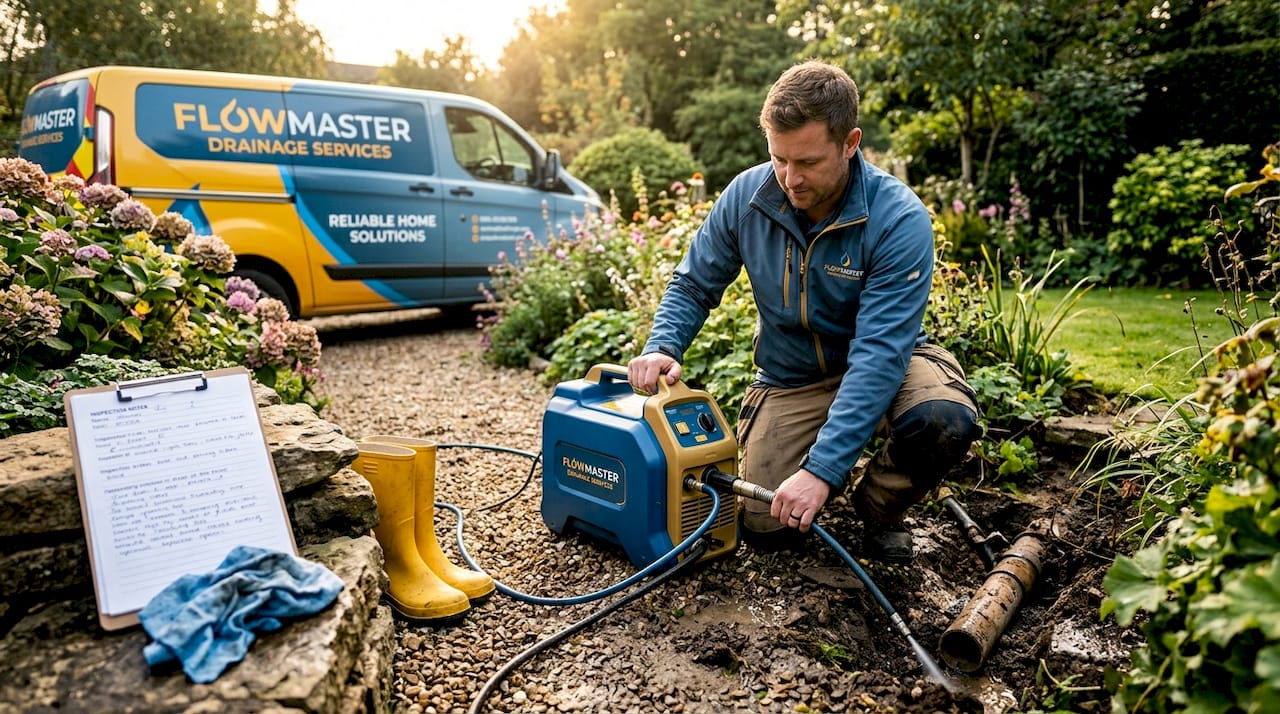
Mechanical cutting using a rotary cutter attachment goes further, physically severing root masses. Reviewing your root removal methods options in detail helps you understand which combination of techniques suits your pipe type and tree species. For older clay pipes common in Southampton’s Victorian-era housing, mechanical cutters require careful use because the pipe walls may already be fragile.
When to use each method in practice:
- Begin with a CCTV drain survey to map the extent of intrusion and check pipe condition.
- Use high-pressure jetting first to flush existing debris and expose the root mass clearly.
- Apply mechanical cutting if roots occupy a significant portion of the pipe bore.
- Follow up with a chemical root inhibitor to slow future regrowth.
- Commission pipe relining or full replacement if the survey reveals structural compromise.
Severe intrusion with over 50% blockage often requires pipe rehabilitation after root removal, not just clearance. This is where many homeowners are caught off guard, assuming clearance alone has resolved the problem.
For those dealing with roots that have caused visible cracking or joint separation, it is worth reading the full guide on removing drain roots to understand the precise steps involved in a professional clearance and why follow-on repair work is so often necessary.
Pro Tip: Never opt for chemical root killers as your first line of defence in an established blockage. They work best as a preventive measure after mechanical clearance, not as a substitute for it.
Hidden risks: what homeowners miss about root and tree removal
Besides clearing roots, responsible property management means anticipating the side effects of removal.
Most homeowners focus entirely on clearing the blockage. Far fewer consider what happens to the surrounding soil and structure when a root system is disturbed or a tree is felled entirely. This oversight can turn a manageable drainage issue into a far more expensive structural problem.
The distinction between minor and structural root intrusion matters greatly here. Minor intrusion means roots have entered a pipe but have not caused cracking or significant joint displacement. Structural intrusion means the pipe wall has been breached, the joints have shifted, or the root mass has exerted enough lateral pressure to affect the pipe’s alignment within the soil.
| Intrusion level | Pipe condition | Typical action required | Risk level |
|---|---|---|---|
| Minor (under 25% bore blocked) | Intact | Jetting and inhibitor | Low |
| Moderate (25 to 50% bore) | Minor cracking possible | Jetting, cutting, monitor | Medium |
| Severe (over 50% bore) | Likely structural damage | Full clearance plus relining | High |
| Critical (complete blockage) | Probable collapse or misalignment | Excavation or full replacement | Very high |
One of the most overlooked risks is soil heave. Removing large trees can trigger soil heave, especially in South UK’s clay soils. Heave occurs when tree roots, which have been drawing moisture from the ground for years, are suddenly removed. The clay soil, no longer drained by the root system, absorbs moisture and expands. This upward ground movement can shift drain pipes, crack foundations, and distort flooring.
Southampton sits on a mixture of clay and gravel-bearing soils, and properties across areas like Bassett, Bitterne, and Shirley are particularly susceptible to this kind of ground movement. It is not a rare occurrence. It is a predictable consequence that professionals account for as part of responsible removal planning.
“Soil heave after large tree removal is not a freak event. In clay-heavy ground, it is one of the most common causes of post-removal structural complaints.”
Before any large tree or significant root system is removed near your drains or property, ask the contractor these key questions:
- Has the soil type been assessed to determine heave risk?
- Will a CCTV drain survey be carried out before and after removal?
- Is the pipe condition already compromised, requiring repair before ground movement occurs?
- What monitoring or aftercare plan is in place once the tree or root is gone?
Investing in non-invasive drain repair techniques such as drain relining after root clearance is often the most cost-effective way to restore structural integrity without adding the disruption of excavation on top of an already complex situation.
Long-term solutions: prevention and post-removal care
Long-term success relies not just on removal, but ensuring roots do not return and that any damage is fully addressed.
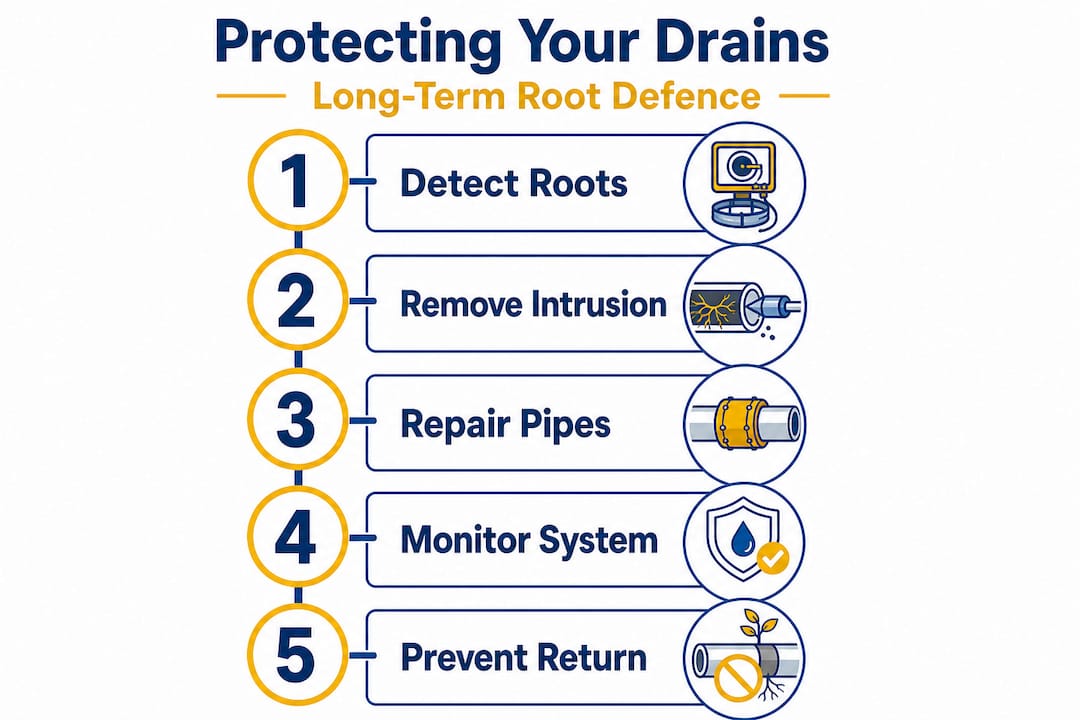
Clearing roots once and walking away is a strategy that rarely works. Roots regrow. Old pipes still have the same cracks and joints that attracted roots in the first place. Without intervention, you are simply resetting the clock on the same problem.
Steps for lasting protection after root removal:
-
Reline or replace compromised pipes. If the survey revealed cracking, joint displacement, or significant wear, relining is the most practical solution. A cured-in-place pipe liner (CIPP) is inserted and cured inside the existing pipe, sealing cracks and creating a smooth bore that roots find far harder to penetrate.
-
Install root barriers. These are physical membranes inserted into the ground between the tree and the drain run. They redirect root growth away from the pipe without harming the tree itself.
-
Schedule regular CCTV surveys. For properties with mature trees within 10 metres of a drainage run, a survey every two to three years is sensible. Catching minor ingress early costs a fraction of dealing with severe blockage or pipe collapse.
-
Be selective with new planting. When planning gardens or replacing trees, avoid fast-growing species with invasive roots near drain lines. Slower-growing, smaller species with compact root systems are far safer choices near your drainage infrastructure.
-
Keep drainage records. Maintain a log of all surveys, clearances, and repairs. This is invaluable for insurance purposes and for giving any future contractor a clear picture of your drainage history.
Tree removal is not always the final step; ongoing monitoring can prevent re-entry and catch new problems before they escalate. The goal is to create a drainage system that is resilient enough to withstand the root pressure that Southampton’s soil and tree cover inevitably generates.
Exploring resources on blockage-free drainage provides additional guidance on maintaining clear, functional drains across all seasons, not just when roots are causing active trouble.
Pro Tip: After any pipe relining work, ask your contractor to carry out a post-lining CCTV pass to confirm the liner has seated correctly and that no gaps or voids remain. This takes minutes and provides real reassurance.
Why the conventional approach to root removal isn’t enough
Here is the uncomfortable truth about how most root removal jobs are handled. A contractor arrives, jets the pipe, maybe cuts the roots mechanically, and signs off the job as done. The homeowner sees clear water flowing freely and assumes the problem is solved. Six to eighteen months later, the blockage is back, often worse than before.
The issue is not the techniques. Jetting and cutting work well within their limitations. The issue is what is being left unexamined. Standard fixes ignore the underground soil conditions and any existing foundation or pipe risks that the root intrusion may have worsened. Aggressive root removal without foundation assessment can create long-term structural risks that no amount of re-jetting will resolve.
The cost of misdiagnosis consistently outpaces the cost of simple blockage clearance. A homeowner who spends a modest amount on a CCTV survey before treatment avoids the far larger bill that follows pipe collapse, soil heave damage, or repeat emergency call-outs.
Southampton’s clay-rich geology makes bespoke solutions genuinely necessary, not a luxury. What works for a property in a sandy coastal town does not automatically apply to a Victorian terrace in Shirley or a newer build in Hedge End sitting on compacted clay. Every removal should start with a thorough survey and finish with tailored aftercare specific to the ground conditions, tree species involved, and pipe materials present.
The professionals who get this right are the ones who treat drainage as a system, not a single pipe. They account for the soil, the structure above it, the trees nearby, and the long-term trajectory of the problem. That is what timely drain repairs and proactive drainage management actually look like in practice.
Expert root removal and drain care in Southampton
If roots are causing trouble with your drains, or if you suspect they might be after reading this, the right next step is a professional assessment from people who understand Southampton’s specific drainage challenges.
At blocked-drainssouthampton.co.uk, we provide the full range of drain services that root-related problems demand, from initial CCTV surveys through to mechanical clearance, chemical treatment, relining, and emergency response. Our local knowledge of Southampton’s soil conditions, historic pipe networks, and tree species means we do not apply generic fixes. We tailor every plan to your property. You can read more on root removal methods or explore your drain repair options directly on the site, or simply get in touch to book an assessment and get ahead of the problem before it escalates.
Frequently asked questions
Will removing roots from a drain solve the blockage for good?
Often, removing roots clears the immediate blockage, but without pipe repair or ongoing prevention, roots can re-enter through the same cracks and joints. Ongoing monitoring is essential to prevent re-entry after any removal.
Can tree or root removal damage foundations in Southampton?
Yes. Large tree removal can cause soil heave, particularly in the clay-bearing soils common across Southampton. Soil heave in clay soils can shift drain pipes and affect building foundations if not managed properly.
What are signs that roots are damaging my drains?
Typical signs include repeatedly blocked pipes, slow-draining fixtures, gurgling sounds from toilets, and persistent foul odours rising from indoor or outdoor drains.
Is it safe to remove roots myself or should I hire a professional?
Professional assessment is strongly advisable. DIY methods such as chemical treatments or hire tools can worsen existing pipe damage or fail to identify the root cause of the problem, leading to costlier repairs later.
What steps prevent future root intrusion after removal?
Lining the repaired pipe, installing root barriers, scheduling regular CCTV surveys, and choosing low-risk plant species near drain runs all provide lasting protection. Ongoing monitoring after removal is a key part of preventing re-entry.